41960 (588159), страница 10
Текст из файла (страница 10)
Total Revenue from Sales
This schedule shows how Meg’s Mart calculates its net sales for 19X2:
MEG’S MART
Calculation of Net Sales
For Year Ended December 31, 19X2
Sales $321,000
Less: Sales returns and allowances . . $2,000
Sales discounts 4,300 6,300
Net sales $314,700
The components of this calculation are described in the following paragraphs.
ILLUSTRATION 1 Classified Balance Sheet for a Merchandising Company
MEG’S MART
Balance Sheet
December 31,19X2
Assets
Current assets:
Cash $ 8,200
Accounts receivable 11,200
Merchandise inventory 21,000
Prepaid expenses 1,100
Total current assets $41,500
Plant and equipment:
Office equipment $ 4,200
Less accumulated depreciation …. 1,400 $ 2,800
Store equipment $30,000
Less accumulated depreciation …. 6,000 24,000
T otal plant and equipment …..... 26,800
T otal assets . . . $68,300
Liabilities
Current liabilities:
Accounts payable . . . $16,000
Salaries payable . … . . 800
Total liabilities …............. $16,800
Owner’s Equity
Meg Harlowe, capital 51,500
Total liabilities and owner’s equity …. $68,300
Sales
The sales item in this calculation is the total cash and credit sales made by the company during the year. Each cash sale was rung up on one of the company’s cash registers when it was completed. At the end of each day, the registers were read and the total cash sales for the day were recorded with a journal entry like this one for November 3:
Nov. 3 Cash …………………………………….1,205.00
Sales……………………………… 1,205.00
Sold merchandise for cash.
This journal entry records an increase in the company’s cash for the amount received from the customers. It also records the revenue in the Sales account.
In addition, a journal entry would be prepared each day to record the credit sales made on that day. For example, this entry records $450 of credit sales on November 3:
Nov. 3 Accounts Receivable …………………….450.00
Sales……………………………… 450.00
Sold merchandise on credit.
This entry records the increase in the company’s assets in the form of the accounts receivable from the customers. It also records the revenue from the credit sales.
Sales Returns and Allowances
To meet their customers’ needs, most companies allow customers to return any unsuitable merchandise for a full refund. If a customer keeps the unsatisfactory goods and is given a partial refund of the selling price, the company is said to have provided a sales allowance. Either way, returns and allowances involve dissatisfied customers and the possibility of lost future sales. Careful managers try to reduce customer dissatisfaction by minimizing returns and allowances. A company’s accountants can help by providing information to the manager about actual returns and allowances. Thus, many accounting systems record returns and allowances in a separate contra-revenue account like the one used in this entry to record a $200 cash refund:
Nov. 3 Sales Returns and Allowances ……….200.00
Cash …………………… 200.00
Customer returned defective merchandise.
The company could record the refund with a debit to the Sales account. Although this practice would provide the same measure of net sales, it would not provide information that the manager can use to monitor the refunds and allowances. By using the Sales Returns and Allowances contra account, the information is readily available. To simplify the reports provided to external decision makers, published income statements usually omit this detail and present only the amount of net sales.
Sales Discounts
When goods are sold on credit, the expected amounts and dates of future payments need to be clearly stated to avoid misunderstandings. The credit terms for a sale describe the amounts and timing of payments that the buyer agrees to make in the future. The specific terms usually reflect the ordinary practices of most companies in the industry. For example, companies in an industry might customarily expect to be paid 10 days after the end of the month in which a sale occurred. These credit terms would be stated on sales invoices or tickets as “n/10 EOM,” with the abbreviation EOM standing for “end of the month.” In other industries, invoices become due and payable 30 calendar days after the invoice date. These terms are abbreviated as “n/30,” and the 30-day period is called the credit period.
When the credit period is long, the seller often grants a cash discount if the customer pays promptly. These early payments are desirable because the seller receives the cash more quickly and can use it to carry on its activities. In addition, prompt payments reduce future efforts and costs of billing customers. These advantages are usually worth the cost of offering the discounts.
If cash discounts for early payment are granted, they are described in the credit terms on the invoice. For example, the terms of “2/10, n/60” mean that a 60-day credit period passes before full payment is due. However, to encourage early payment, the seller allows the buyer to deduct 2% of the invoice amount from the payment if it is made within 10 days of the invoice date. The discount period is the period in which the reduced payment can be made.
At the time of a credit sale, the seller does not know that the customer will pay within the discount period and take advantage of a cash discount. As a suit, the discount is usually not recorded until the customer pays within the discount period. For example, suppose that Meg’s Mart completed a credit sale on November 12 at a gross selling price of $100, subject to terms of 2/10, i/60. The sale is recorded with this entry:
Nov. 12 Accounts Receivable …………………100.00
Sales ………………………………… 100.00
Sold merchandise under terms of 2/10, n/60.
.
Even though the customer may pay less than the purchase price, the entry records the receivable and the revenue as if the full amount will be collected. In fact, the customer has two alternatives. One option is to wait 60 days until January 11 and pay the full $100. If this option is chosen, Meg’s Mart records the collection with this entry:
Jan 11 Cash ……………………………………… 100.00
Accounts Receivable …………………… 100.00
Collected account receivable.
The customer’s other option is to pay $98 within a 10-day period that runs through November 22. If the customer pays on November 22, Meg’s Mart records the collection with this entry:
Nov. 12 Cash …………………………………………….. 98.00
Sales Discounts ……………………………… 2.00
Accounts Receivable…………………….. 100.00
Received payment for the November 12
sale less the discount.
Cash discounts granted to customers are called sales discounts. Because management needs to monitor the amount of cash discounts to assess their effectiveness and their cost, their amounts are recorded in a contra-revenue account called Sales Discounts. The balance of this account is deducted from the balance of the Sales account when calculating the company’s net sales. Although information about the amount of discounts is useful internally, it is seldom reported on income statements distributed to external decision makers.
Measuring Inventory and Cost of Goods Sold
A merchandising company’s balance sheet includes a current asset called inventory and its income statement includes the item called cost of goods sold. Both of these items are affected by the company’s merchandise transactions. The amount of the asset on the balance sheet equals the cost of the inventory on hand at the end of the fiscal year. The amount of the cost of goods sold is the cost of the merchandise that was sold to customers during the year.
Two different inventory accounting systems may be used to collect information about the cost of the inventory on hand and the cost of goods sold. They are described in the following paragraphs.
Periodic and Perpetual Inventory Systems
The two basic types of inventory accounting systems are called perpetual and periodic. As suggested by their name, perpetual inventory systems maintain a continuous record of the amount of inventory on hand. This perpetual record is maintained by adding the cost of each newly purchased item to the inventory account and subtracting the cost of each sold item from the account. When an item is sold, its cost is recorded in the Cost of Goods Sold account. Users of perpetual systems can refer to the balance of the inventory account to determine the cost of the items that remain on hand. They can also refer to the balance of the Cost of Goods Sold account to determine the cost of the merchandise sold to customers.
Before the development of inexpensive and easy-to-use computer programs, perpetual systems were generally applied only by businesses that made a limited number of sales each day, such as automobile dealers or major appliance stores. Because there were relatively few transactions, the perpetual accounting system could be operated efficiently. However, the availability of improved technology has greatly increased the number of companies that use perpetual systems.
Under periodic inventory systems, a company does not continuously update its records of the quantity and cost of goods on hand or sold. Instead, the company simply records the cost of new merchandise in a temporary Purchases account. When merchandise is sold, only the revenue is recorded. When financial statements are prepared, the company takes a physical inventory by counting the quantities of merchandise on hand and determines the inventory’s total cost from records that show each item’s original cost. This total cost is then used to determine the cost of goods sold.
Traditionally, periodic systems were always used by companies such as drug and department stores that sold large quantities of low-valued items. Without computers and scanners, it was not feasible for accounting systems to track such small items as toothpaste, pain killers, clothing, and housewares through the inventory and into the customers’ hands.
Although perpetual systems are now more affordable, they are still not used by all merchandising companies. As a result, it will be helpful for you to understand how periodic systems work. In addition, studying periodic systems will help you visualize the flow of goods through inventory without having to learn the more complicated sequence of journal entries used in perpetual systems.
Calculating the Cost of Goods Sold with a Periodic Inventory System
As mentioned earlier, a store that uses a periodic inventory system does not record the cost of merchandise items when they are sold. Rather, the accountant waits until the end of the reporting period and determines the cost of all the goods sold during the period. To make this calculation, the accountant must have information about:
-
The cost of the merchandise on hand at the beginning of the period.
-
The cost of merchandise purchased during the period.
-
The cost of unsold goods on hand at the end of the period.
Look at Illustration 2 to see how this information can be used to measure the cost of goods sold for Meg’s Mart.
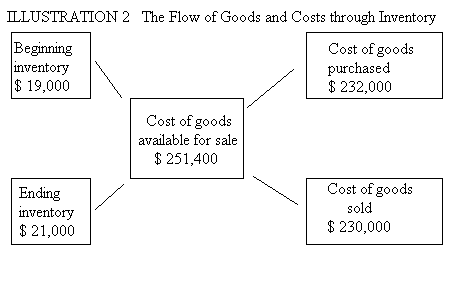
In Illustration 2, note that Meg’s Mart had $251,400 of goods available for sale during the period. They were available because the company had $19,000 of goods on hand when the period started and purchased an additional $232,400 of goods during the year. The available goods were then either sold during the period or on hand at the end of the period. Because the count showed that $21,000 were on hand at the end of the year, we can conclude that $230,400 must have been sold. This schedule presents the calculation: