116321 (592438), страница 12
Текст из файла (страница 12)
1. Соотносимость узагальнювальних і приватних завдань уроку.
| Узагальнені типи завдань | Приватні мовні завдання |
| Повідомлення | повідомити повідати доповісти передати рапортувати переказати сповістити інформувати |
| Пояснення | Охарактеризувати відтіняти показати загострити увагу конкретизувати коментувати уточнити описати акцентувати виділити |
| Схвалення | Рекомендувати виправдати порадити підтримати підтвердити похвалити напоумити вибачити підказати привітати побажати поблагодарить |
| Засудження | покритикувати присоромити спростувати звинуватити заперечити протестувати заперечувати оспорити відкинути |
| Переконання | довести підштовхнути обгрунтувати надихнути запевнити надихнути схилити наполягти спонукати прохати вселити умовити |
2. План уроку.
Мета уроку:
а) учбова — розвиток уміння говорити (завдання: виучувати монологическому вислову типа "засудження", учити заперечувати, критикувати, опровергать думка іншого);
б) виховна — щепити смак до справжньої музике.
Мовний матеріал:
а) весь матеріал даного циклу уроків по темі;
б) висказивания для аудирования.
Оснащення уроку: магнітофонні записи висловів для аудирования, ілюстрації до окремих висловів.
3. Хід уроку.
1. Мовна зарядка: розповідь про те, як багатообразні захоплення (хобі) людей (згадуються захоплення, безумовно, гідні наслідування, показивается їх користь).
2. "А тепер розкажіть нам, у кого із знаменитих людей було хобі і какое" (це перевірка домашнього завдання — знайти цікаві повідомлення і дуже коротко проінформувати клас).
3. "А які захоплення у вас?" (протягом двох хвилин вчитель з'ясовує захоплення окремих учнів, оцінює їх).
4. "Не всі захоплення, проте, корисні. Є та інші. Ось послушайте, что розповідає про своє хобі одна дівчина і скажіть, як ви до цього относитесь" (включається запис вислову, де дівчина говорить про те, як вона проводить цілі дні біля телевізора). Учні по ходу прослухування роблять собі позначки.
5. Як опори використовуються наступні логико-синтаксические схеми:
а) Виразите засудження: невже...; мабуть, вона....; я, наприклад.....;
довкола...; я, вважаю....; і так далі
б) Виразите незгоду: я думаю....; нічого поганого....; бувають....; адже....; телебачення....; і так далі
в) Віднесіться критично: це...; але....; по-перше...., по-друге....; навіть...; тому...; і так далі
2 Тема: В світлофора на перехресті.
Мета — навчитися переходити вулицю.
Ролі — мати і діти.
Варіанти: старший брат і молодший брат; міліціонер і дитя;
вчитель і учні.
Умова — різний рівень інформованості.
Прогнозований продукт:
1) Монолог старшого (дорослого):
Stop before you cross the street. Look at the traffic light. When the light is red, wait at the corner. When the light is green, cross the street.
2) Діалог:
Старший (в перехрестя): Stop, children!
Діти: Why did we stop?
Старший: Look at the light before you cross. What colour is the light now?
Діти: It is red.
Старший: The red light says: "Stop." So, when the light is red, wait at the corner.
Діти: When shall we go?
Старший: When the light says "Go." When the light is green cross the street. Діти: Look, mother (teacher, brother) the light is green now. May we cross the street? Старший: Yes, the light is green and the road is clear. Let us cross the street. Граматика: підрядні речення часу (умови); наказові пропозиції. Лексика: to cross, to stop, to look, to wait, to go, may, street, light, corner, red, green.
Додаток 3
Функціональні моделі діалогу.
Слабкий учень Сильний учень
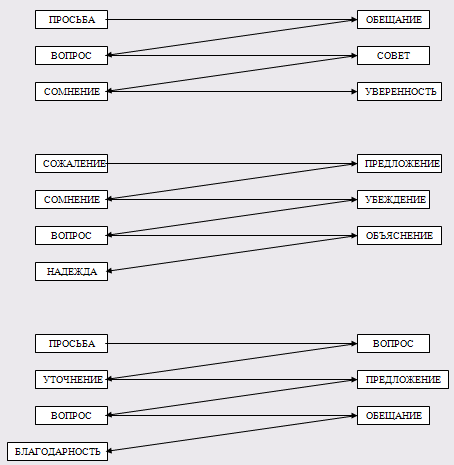
Додаток 4
Комплекс вправ 1.
I. Practise the sound combinations given below and read the dialogue carefully.
is 'this
is 'that
is 'this the ho'tel
is 'that all right
II. Find English equivalents for the following (See Text).
- це готель, в якому ми зупинимося ...
- я піду і позабочусь про номери ...
- мені потрібно два одинарні номери ...
- у нас майже немає вільних номерів ...
- ми пробудемо тут близько тижня ...
- ви можете отримати один подвійний номер ...
- все правильно? ...
- хлопчик проводить вас у вашу кімнату і занесе ваш багаж ...
III. Retell the dialogues in indirect speech.
IV. Activate the following words and word combinations.
to book (а room, а ticket, а seat)
a) Answer these questions.
1. Do you usually book а hotel room in advance when you go away on business?
2. In what way can one book а railway ticket {а seat in the theatre)?
3. Can we book а return ticket when we go to the Caucasus?
4. Why is it advisable to book а return ticket?
b) Translate.
1. Я вас провожу (до дверей).
2. Мене провели в кімнату і попросили небагато почекати.
3. Він проводив нас до станції (додому, в театр).
4. Нам дали ключі і проводили нас до нашої кімнати.
5. Повісьте пальто і капелюх тут. Я проведу вас в кабінет директора.
6. Я прийшов проводити вас.
7. Секретар проводив пана Сміта вгору.
8. Покажіть мені театр (проведіть мене по театру), будь ласка. Мені сказали, що тут є фотографії всіх видатних актеров цього театру.
V. Answer the following questions. Make up stories based on the information gained from the answers (to be done after each set).
a) 1. Have you travelled much?
2. Are you fond of travelling? Why?
3. How do you like to travel? By air, by rail, by sea? Why?
b) 1. Where can one book а seat on а train (а plane, а steamer)
in Moscow?
2. Do you usually book tickets in advance or just before your departure? Why?
3. Do you usually buy (book) а single or а return ticket? Why?
4. Do you like to have an upper or а lower berth? Why?
5. When do we have to apply (звертатися) to the enquiry office for information?
6. When do we have to use the left-luggage office?
7. Why do you sometimes ask а porter to help you with your luggage?
c) 1. Do you often travel on business?
2. Where were you on your last business trip?
3. On arriving there you put up at а hotel immediately, didn't you?
4. Had а room already been booked for you? Why?
5. Did you have а single or а double room?
6. How did you like the service there?
d). What do you usually do on arriving at а hotel?
2. What do you ask the clerk at the reception desk?
3. What does а guest usually have to do at the reception desk?
4. Are you shown up to .your room or do you find the way there yourself?
e) 1. Where did you spend your last holiday?
2. Is there а through train to ... or did you have to change trains?
3. Did you travel by fast or slow train?
4. Did you have а pleasant journey?
5. How long did the journey last?
VI. Make up dialogues, using the words and expressions given below; use disjunctive questions and the expressions so do I, neither do I.
1. At Home
to pack, to have а lot to do, to have ... at one's disposal, to forget, to book, an upper berth, а lower berth, anything will do, don't bother, to order а taxi, to miss the train, to mind, to go by bus
2. At the Booking-office
can I have а ticket to ..., what's the fare, а first-class sleeper, а second-class sleeper, а through train, to change, you will have to ..., а fast train, а slow train, no vacant seats, there is nothing to be done, а dining-car, I think so
3. At the Station
here we are, to see off, to see to the luggage, the left-luggage, the enquiry office, to look up the time-table, to collect one's luggage, а carriage, а compartment, а seat, to come along, the train, to start,, to get on the train, to say goodbye, а pleasant journey
4. On the Train
can I use .... to make oneself comfortable, at one's disposal, to move up, can I help you ..., will you ..., to fix, aren't you going to ..., on business, do you find ..., .the service, to improve, quite comfortable
VII. Describe а trip you have made in Russia or abroad (за кордон).
Додаток 5
Комплекс вправ 2.
I. a) Make comparisons, using the adjectives and adverbs below.
Models:
1. The play is (much) more interesting than the book on which it was based.
In fact it's the best play of the season.
2. It is produced (much) better than many other plays. (This play isn't produced as well as some other plays.)
4. N. plays best (of all).
5. The first act is as (is not so) interesting as the second. ,
b) Compare two plays (films, TV shows).
interesting, serious, amusing, cheerful, gloomy,, funny, good (well), popular, bad (badly)
c) Compare two actors (actresses).
talented, popular, famous, skilled, (to do) well, powerful (about а voice), natural, nice (nicely), expressive, (to impress) very much.
II. Find English equivalents for the following (See Text).
- які фільми йдуть на цьому тижні?...
- власне, кажучи ...
- я не зовсім з вами згоден ...
- на екрані...
- якої ви думки про екранізацію? ...
- від початку до кінця ...
- я не нудьгував ні хвилини ...
- склад виконавців добре підібраний ...
- я повинен піти, поглянути його самого ...
- поглянемо ...
III. Activate the following words and word combinations.
the fact is ..., as а matter of fact
a) Complete, using the word combinations given in brackets.
1. I took him to see nearly all the places of interest. In fact... (to show round the whole town).
2. He hesitated for а week before giving а final reply. As а matter of fact he... (not to give а proper answer even then).
3. The boy could not leave his brother. The fact was... (to be responsible for).
b) Translate.
1. Ви не можете винити її за погану гру. Власне кажучи, вона ніколи не виучувалася грі на роялі.
2. Не удивительно, що її скрізь хвалять. Власне кажучи, вона найпопулярніша актриса сезону.
to prefer, I would rather ... than....
a) Practise aloud.
1. Do you prefer а single or а double room?
2. I'd prefer а single room.
3. I prefer to wear glasses at work.
4. He'd prefer not to consider the question now.
5. She prefers wearing her hair long.
6. I would rather look it up than try to guess.
b) Answer these questions.
1. What kind of sports do you prefer in summer (in winter)?
2. Why do you prefer swimming (playing tennis, volley-bali, skating)?
3. Why do some people prefer the cinema to the theatre?
4. Do you travel а lot? How do you prefer to travel?
5. When would you rather go by train than by air?
V. Answer the following questions. Make up stories based on the information gained from the answers (to be done after each set).
a) 1. Do you often go to see ballets, or do you prefer the opera? (Give your reasons.)
2. What ballet (opera) have you seen (heard) lately?
3. Was the plot quite new to you, or were you familiar with it?
4. What is your opinion of the performance? Do other people praise it?
b) 1. Do you usually go to see every new film, or only those which are praised?
2. What kind of them do you look forward to seeing?
3. Do you expect to enjoy а film with а familiar plot? (Give your reasons for or against.)
VI. Make an oral translation, using the active vocabulary of the lesson.
Діалог 1.
- Адже ви бачили новий спектакль в нашому театрі, так? Як він вам сподобався?
- Здається, це прекрасний спектакль. Власне кажучи, вміст був мені знайомо, але проте (but ... just the same) мені сподобався весь спектакль від, почала до кінця. Артисти підібрані прекрасно, що веде роль виконувала Миколаєва.
- Правда? Я вважаю за краще Петрову в цій ролі.
Діалог 2.
- Ви бачили останні картини цього художника? Вони демонструються (показуються) в головному виставковому залі.
- Немає ще, я був дуже зайнятий останнім часом. Але цю виставку всі хвалять, і я хочу поглянути її.