5 translate (1234102)
Текст из файла
2 A place and a role of the enterprises of the Russian Far East in development of timber market of the countries of SVA
2.1 The analysis of the regional market and its interaction with the countries of Northeast Asia
The highest extent of orientation to the market of the countries of SVA is characteristic for forest export of the Russian Far East (99,4%). It is important to note that in recent years the most part of export streams of this branch was reoriented on the Chinese market. If in the 90th of last century the main consumer of a forest product was Japan (more than 80% of export), so far the share of the People's Republic of China (more than 68%) sharply increased in structure of forest export of the region.
"The Far East woods occupy about 39% of the total area of the Russian woods and 28% of volume of all extracted wood in the territory of Russia, and the territories suitable for cutting down make about 66 million cubic meters. The area of the Far East woods makes about 280 hectares., and a wood reserve – 21 billion cubic meters.
The woods available to carrying out normal cuttings down in the Far East make, about, 39% from is general the areas of all woods. As the reason for that inaccessibility of some forest grounds, stay them in the territory of the protected zones, for example, of reserves serves."
The most "effective" woods are in the territory adjacent to Sikhote-Alin, in the north of the Amur region, in the southern part of Yakutia and in a middle part of Sakhalin.
In Primorye and on Sakhalin about 10% of forests which are not available to a cutting area settle down. And in Yakutia and Khabarovsk Krai the share of undeveloped forest fund makes above35-45%.
Certainly, for the Far East region, the leading branch is the wood industry. Logging in the Far East in 2013 made about 14 million cubic meters. The region occupies powerful part in the all-Russian timber export, in production of paper and other forest production.
Apparently from figure 2.1.1, The main concentration of wood industry is the share of the Amur region, on Seaside and the Khabarovsk regions. They are leaders in many positions. So, their participation in export of the wood makes 8%, 55% and 25%. Participation in production of business wood – 8,6%, 57% and 17,4%; in production of timber – 2,5%, 51,2% and 21%, respectively.
Apparently in drawing, Seaside edges the Far East federal district is the leader in forest branch among subjects of the Far East federal district.
In the south of the Far East region – in Khabarovsk and Primorsk edges, the Sakhalin and Amur areas on each 100 square meters of total area, 54 cubic meters of the woods are necessary.
The largest bases specialized on logging are located in regions of the Central and Lower Amur, throughout all Ussuri, on Zeya, Bureya, in the central and southern parts of Sakhalin.
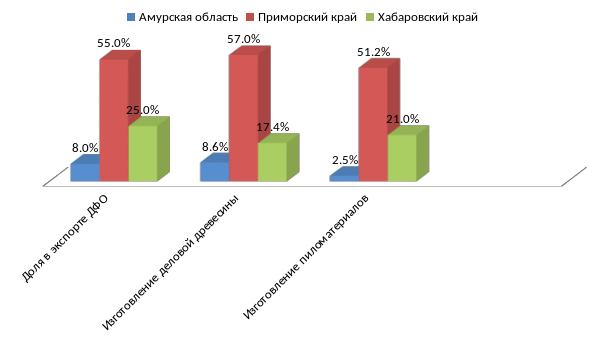
Picture 2.1.1 Subjects of the Far East federal district, leaders in forest branch following the results of 2013 [13]
Refer to the most important objects of sawmilling: Lesozavodsk, Blagoveshchensk, Khabarovsk, Vladivostok; production of furniture are engaged in Birobidzhan, Khabarovsk and Vladivostok. On Sakhalin pulp-and-paper production is most developed.
Apparently in Table 2.1.1, for 2013 in the territory of the Far East region 25483 cubic meters of the business wood, production of timber – 1071,8 cubic meters were made. Proceeding from these data, it is possible to draw a conclusion: stocks of the Far East wood are capable to execute the government plan, but it is not enough available capacities for effective processing of the got wood.
Table 2.1.1 – Production of forest production in 2013 in one thousand cubic meters
| Export of the wood | Business wood | Timber | |||
| Republic of Sakha (Yakutia) | 703 | 478,4 | 152,8 | ||
| Primorsky Krai | 4118,1 | 3558,4 | 246,6 | ||
| Khabarovsk Krai | 8414,2 | 7498,6 | 567,2 | ||
| Amur region | 1060,2 | 905,3 | 21,8 | ||
| Sakhalin region | 318,6 | 300,8 | 63 | ||
| Jewish Autonomous Oblast | 264,2 | 255,8 | 20,4 | ||
| Far East region | 14878,3 |
| 1071,8 |
According to Table 2.1.1 it is possible to say a conclusion that leaders of forest branch in the Far East federal district are the Khabarovsk and Seaside regions, the Amur region which total output makes ¾ from the total amount of the made production across the Far East.
Forest production Far East federal district – is focused on export. Apparently in Table 2.1.3, from the territory of the Far East 24617,6 thousand cubic meters of wood were taken out to the countries of Northeast Asia for 2013, by a total cost of 1374,8 million US dollars.
Table 2.1.2 – Quantity and cost of the wood exported to the countries of Northeast Asia for 2013
| The country - the importer | of Thousand cubic meters | Cost, mln. dollars of the USA |
| China | 12982,3 | 683,1 |
Termination of the table 2.1.2
| Japan | 8301,6 | 547,4 |
| Republic of Korea | 3324,5 | 143,6 |
| Democratic People's Republic of Korea | 9,2 | 0,7 |
| All | 24167,6 | 1374,8 |
The most important importers of the Far East wood are the countries of Northeast Asia: China, Republic of Korea and Japan.
Following the results of 2013, to the countries of Northeast Asia it was taken out: to China – 80% of the total amount of export forest raw materials and 89% of timber; to the Republic of Korea – 17% of a round timber and 7% of the processed materials. One more important contractor is Japan. 5% of the taken-out wood, from them fall to the share of the Japanese consumer: 4% of the total amount of forest raw materials and 2% - from the processed materials.
After the entry of the Russian Federation into structure of the World Trade Organization (WTO), purchase of the wood in the Far East began to manage too expensive for his traditional importers. Now, the leading positions in export of the wood to the countries of Northeast Asia were taken by suppliers from the USA, Canada and New Zealand.
Current situation – result of government intervention, in particular, introductions of "protecting" duties on the exported raw wood. It was made with the purpose to stimulate development of the overworking enterprises.
Because of introduction of high export duties, the countries of Northeast Asia are compelled to reduce volumes of purchases of the Far East wood. For the last three years export of goods of forest branch in this direction sharply decreased: to China for 21,1% (2,3 million m3), to Japan and South Korea for 20% and 36%.
Summing up the results by 2013 it is possible to tell that China, still, remains the leader in import of the Far East raw wood, but thus, deliveries of a round timber from the territory of the Far East federal district steadily decrease. Thus, in 2013 deliveries to China fell to 12% that makes about 7700 thousand cubic meters, with a total amount of 1,08 billion rubles. The increase in a share of import of the raw round timber, first of all, from New Zealand, Canada, the USA became the reason for that; also, as the reason delay of growth rates of economy of China serves.
It should be noted that export of a business round timber in 2013 was made on the lowered custom duties. On average, the foreign trade prices of the exported raw wood by results of 2013 made 140,5 dollars for cubic meter (against 128 dollars in 2012), thus, that the average price of the imported round timber for 2013 made 205 dollars.
At this stage in China the situation of an acute shortage of own resources remains. The government of China set a goal on creation of the state stocks of the wood, thus having kept own resources.
So, in the province rich with forest grounds Helongjiang (People's Republic of China), 25 customs posts through which the Far East wood is imported are concentrated. The border with Russia has total length about 3000 kilometers here.
In the same 2013 export of a round timber to the Republic of Korea decreased on volumes almost by 4%, compared with 2012 and made about 630 thousand cubic meters. Thus, the profit on export increased for 8% that made 85 mln. dollars it occurred because of growth of the export prices.
By the end of 2013 the Republic of Korea went down from the second position on the fourth in the list of the main importers of a Far East round timber.
In 2013 in a total amount of export of the Far East raw wood the share of the Republic of Korea did not exceed 4,7%. By delivery to Korea 1 cubic meter. round timber meter in 2013, the average export price made 128 dollars for cubic meter. In the previous year, the same volume could be got for 116 dollars.
Low economic efficiency of a Far East forest complex – result of low extent of processing of wood raw materials. In comparison with the all-Russian indicators, the revenue of a forest complex of the Far East from one cubic meter is nearly 1,5 times less. It became result of absence of the enterprises of deep processing of the got wood.
Low indicators of processing of forest raw materials in Far East LPK are also the main barrier to increase of efficiency of a forest complex of the region.
At the same time, already available refinery capacities do not work at full capacity. Thus, for 2013 in Khabarovsk Krai real load of the enterprises made 63,4%, in 2014 - 64,7%; in Primorye in 2012 – 48,9%.
The share of the unprofitable enterprises of a forest complex in the Russian Far East in 2012 - 2013 in the sum made, about, 38,9% - in Khabarovsk Krai, in Primorye – 47,1%, in the Jewish Autonomous Oblast – 67,1%, in Yakutia – 67,7%, in the Amur region – 43,2%.
From here the conclusion follows that the condition of a regional forest complex is not in the best situation. At this stage, the government makes huge efforts to bring forest branch of the region out of a crisis state.
"The largest enterprises of timber processing complex of the Far East are:
- RFP Group. An official date of creation - 2004 when as a result of merger of the logging enterprises of the Far East by the Russian Federation and the largest shipping company of Khabarovsk Krai "RFP of Groups" was among the leading timber industry holdings of Russia.
Sphere of action - wood preparation, processing of the wood, sale and delivery of forest production to the countries of the Pacific Rim, and also management of a logistic complex, including freight, passenger traffic, services on sea and river routes of the Far East.
As a part of "RFP of Groups" leading enterprises of the region are engaged in preparation. The largest of them - "Dallesprom" and "Flora".
For forest processing "The Far East center of deep processing of wood" is created, in 2009 it is included in the list of priority investment projects in the field of development of the woods. About 6 thousand people work at the enterprises of holding located in the Amur region, Khabarovsk and Primorsk edges.
- "Arkaim" it is formed in 1993. The company began the activity with preparation of the wood, and today this activity remains to one of key in its work.
Capacities of the overworking complex are calculated on production of 350 thousand m3 of dried timber and 40 thousand m3 of wood plates a year.
The main consumers of production - the company of Japan, China, the Republic of Korea and the countries of Europe.
- "Rimbunan Hidzhau". The enterprises of holding conduct the activity since 2007. Now Rimbunan Hidzhau International, Rimbunan Hidzhau DV, Forist Starma and Rimbunan Hidzhau MDF are included into Malaysian holding Rimbunan Hijau Group (RH Group). Cumulative power of the enterprises of holding - about 600 million m3 a year that makes 14% of all volume of the prepared wood in Khabarovsk Krai.
The let-out forest production is sent for export to Japan, China, South Korea by railway and sea transport through boundary transition of "Grodekovo" and seaports of Nakhodka, Vladivostok.
In 2007 during the first Far East international economic forum, in connection with the decision of the government of Khabarovsk Krai on development of the woodworking industry, the Rimbunan Hidzhau group of companies signed the cooperation agreement with the government of Khabarovsk Krai and constructed plant, the first in the Far East, on production of plates of MDF with an annual volume of production of 180 thousand m3.
Характеристики
Тип файла документ
Документы такого типа открываются такими программами, как Microsoft Office Word на компьютерах Windows, Apple Pages на компьютерах Mac, Open Office - бесплатная альтернатива на различных платформах, в том числе Linux. Наиболее простым и современным решением будут Google документы, так как открываются онлайн без скачивания прямо в браузере на любой платформе. Существуют российские качественные аналоги, например от Яндекса.
Будьте внимательны на мобильных устройствах, так как там используются упрощённый функционал даже в официальном приложении от Microsoft, поэтому для просмотра скачивайте PDF-версию. А если нужно редактировать файл, то используйте оригинальный файл.
Файлы такого типа обычно разбиты на страницы, а текст может быть форматированным (жирный, курсив, выбор шрифта, таблицы и т.п.), а также в него можно добавлять изображения. Формат идеально подходит для рефератов, докладов и РПЗ курсовых проектов, которые необходимо распечатать. Кстати перед печатью также сохраняйте файл в PDF, так как принтер может начудить со шрифтами.