72699 (701699)
Текст из файла
Department of education and science of Ukraine
Ukrainian state university of chemical engineering
Department of foreign languages
Taras Shevchenko
st. gr. G-77
Galutva A.
Dniepropetrovsk
2007
Taras Shevchenko
| Taras Hryhorovych Shevchenko | |
| | |
| Born: | March 9 [O.S. February 25] 1814 |
| Died: | March 10 [O.S. February 26] 1861 |
| Occupation: | Poet and artist |
| Nationality: | Ukrainian |
| Writing period: | 1840-1861 |
| Debut works: | Kobzar |
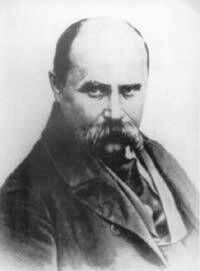
Taras Hryhorovych Shevchenko (Ukrainian: Тарас Григорович Шевченко) (March 9 [O.S. February 25] 1814 – March 10 [O.S. February 26] 1861) was a Ukrainian poet, also an artist and a humanist. His literary heritage is regarded to be the foundation of modern Ukrainian literature and, to a large extent, of modern Ukrainian language. Shevchenko also wrote in Russian and left many masterpieces of his artistic work.
Life
Born into a serf family in the village of Moryntsi, of Kiev Governorate of the Russian Empire (now in Cherkasy Oblast, Ukraine. Shevchenko was orphaned at the age of eleven.[1] He was taught how to read by a village precentor, and loved to draw at every opportunity. Shevchenko served his owner Pavel Engelhardt in Vilnius (1828–1831) and then Saint Petersburg.
Engelhardt noticed Shevchenko's artistic talent, and in Saint Petersburg he apprenticed him to the painter Vasiliy Shiriaev for four years. There he met the Ukrainian artist Ivan Soshenko, who introduced him to other compatriots, such as Yevhen Hrebinka and Vasyl Hryhorovych, and to the Russian painter Alexey Venetsianov. Through these men Shevchenko also met the famous painter and professor Karl Briullov, who donated his portrait of the Russian poet Vasily Zhukovsky as a lottery prize, whose proceeds were used to buy Shevchenko's freedom on May 5, 1838.[1]
First Successes


Self-portrait of Taras Shevchenko, 1840.
In the same year Shevchenko was accepted as a student into the Academy of Arts in the workshop of Karl Briullov. The next year he became a resident student at the Association for the Encouragement of Artists. At the annual examinations at the Imperial Academy of Arts, Shevchenko was given a Silver Medal for a landscape. In 1840 he again received the Silver Medal, this time for his first oil painting, The Beggar Boy Giving Bread to a Dog.
He began writing poetry while he was a serf and in 1840 his first collection of poetry, Kobzar, was published. Ivan Franko, the renowned Ukrainian poet in the generation after Shevchenko, had this to say of the compilation: "[Kobzar] immediately revealed, as it were, a new world of poetry. It burst forth like a spring of clear, cold water, and sparkled with a clarity, breadth and elegance of artistic expression not previously known in Ukrainian writing."
In 1841, the epic poem Haidamaky was released. In September of 1841, Shevchenko was awarded his third Silver Medal for The Gypsy Fortune Teller. Shevchenko also wrote plays. In 1842, he released a part of the tragedy Nykyta Hayday and in 1843 he completed the drama Nazar Stodolya.
While residing in Saint Petersburg, Shevchenko made three trips to Ukraine, in 1843, 1845, and 1846. The difficult conditions under which his countrymen lived had a profound impact on the poet-painter. Shevchenko visited his still enserfed siblings and other relatives, met with prominent Ukrainian writers and intellectuals such as: Yevhen Hrebinka, Panteleimon Kulish, and Mykhaylo Maksymovych, and was befriended by the princely Repnin family especially Varvara Repnina.
In 1844, distressed by the tsarist oppression and destruction of Ukraine, Shevchenko decided to capture some of his homeland's historical ruins and cultural monuments in an album of etchings, which he called Picturesque Ukraine.
Exile
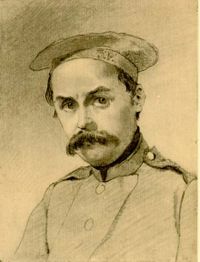
Self-portrait as a soldier, 1847.
On March 22, 1845, the Council of the Academy of Arts decided to grant Shevchenko the title of an artist. He again travelled to Ukraine where he met the historian, Nikolay Kostomarov and other members of the Brotherhood of Saints Cyril and Methodius, a secret political society, created to advocate a wide set of political reforms in the Russian Empire.[1] Upon the society's suppression by the authorities, Shevchenko was arrested along with other members on April 5, 1847. Although he probably was not an official member of the Brotherhood, during the search his poem "The Dream" ("Son") was found. This poem criticized imperial rule and therefore was considered extremely dangerous and of all the members of the dismantled society Shevchenko was punished most severely.
Shevchenko was sent to prison in Saint Petersburg. He was exiled as a private with the Russian military Orenburg garrison at Orsk, near Orenburg, near the Ural Mountains. Tsar Nicholas I, confirming his sentence, added to it, "Under the strictest surveillance, with a ban on writing and painting." It was not until 1857 that Shevchenko finally returned from exile after receiving a pardon, though he was not permitted to return to St. Petersburg but was exiled to Nizhniy Novgorod. In May of 1859, Shevchenko got permission to go to Ukraine. He intended to buy a plot of land not far from the village of Pekariv and settle in Ukraine. In July, he was arrested on a charge of blasphemy, but was released and ordered to return to St. Petersburg.
Death of Shevchenko
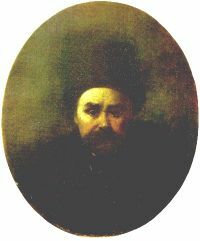

The last self-portrait. 1860.
Taras Shevchenko spent the last years of his life working on new poetry, paintings, and engravings, as well as editing his older works. But after his difficult years in exile his final illness proved too much. Shevchenko died in Saint Petersburg on March 10, 1861. He was first buried at the Smolensk Cemetery in Saint Petersburg. However, fulfilling Shevchenko's wish, as expressed in his poem "Testament" (Zapovit), to be buried in Ukraine, his friends arranged to transfer his remains by train to Moscow and then by horse-drawn wagon to his native land. Shevchenko's remains were buried on May 8 on Chernecha Hora (Monk's Hill; now Tarasova Hora or Taras' Hill) by the Dnieper River near Kaniv.[1] A tall mound was erected over his grave, now a memorial part of the Kaniv Museum-Preserve.
Dogged by terrible misfortune in love and life, the poet died seven days before the Emancipation of Serfs was announced. His works and life are revered by Ukrainians and his impact on Ukrainian literature is immense.
Heritage and legacy
Impact

A monument to Taras Shevchenko in Kiev, Ukraine, is located across the Kiev University that bears the poet's name.
Taras Shevchenko has a unique place in Ukrainian cultural history and in world literature. His writings formed the foundation for the modern Ukrainian literature to a degree that he is also considered the founder of the modern written Ukrainian language (although Ivan Kotlyarevsky pioneered the literary work in what was close to the modern Ukrainian in the end of the eighteenth century). Shevchenko's poetry contributed greatly to the growth of Ukrainian national consciousness, and his influence on various facets of Ukrainian intellectual, literary, and national life is still felt to this day. Influenced by Romanticism, Shevchenko managed to find his own manner of poetic expression that encompassed themes and ideas germane to Ukraine and his personal vision of its past and future.
In view of his literary importance, the impact of his artistic work is often missed although his contemporaries valued his artistic work no less, or perhaps even more, than the literary one. A great number of his pictures, drawings and etchings preserved to this day testify for his unique artistic talent. He also experimented with the photography and it is little known that Shevchenko may be considered to have pioneered the art of etching in the Russian Empire (in 1860 he was awarded the title of the Academician in the Imperial Academy of Arts specifically for his achievements in etching.)[2]
His influence on the Ukrainian culture has been so immense, that even at Soviet times, the official position was to downplay strong Ukrainian nationalism expressed in his poetry, suppressing any mention of it, and to put an emphasis on the social and anti-Tsarist aspects of his legacy, the Class struggle within the Russian Empire. Shevchenko, who himself was born a serf and suffered tremendously for his political views in opposition to the established order of the Empire, was presented in the Soviet times as an internationalist who stood up in general for the plight of the poor classes exploited by the reactionary political regime rather than the vocal proponent of the Ukrainian national idea.
This view is significantly revised in modern independent Ukraine where he is now viewed as almost an iconic figure with the unmatched significance for the Ukrainian nation, the view that has been mostly shared all along by the Ukrainian diaspora that has always revered Shevchenko.
Monuments and Memorials

The ceremonial opening of the monument by the Latvian sculptor Janis Tilbergs to Taras Shevchenko in Petrograd (Saint Petersburg) on December 1, 1918. The inscription says: "To the great Ukrainian poet-pesant T. G. Shevchenko (1814 - 1861) from the great Russian nation." The plaster monument existed for only eight years due to the deterioration of the material in the open air. It was planned to be replaced by a bronze version which never happened.
There are many monuments to Shevchenko throughout Ukraine, most notably at his memorial in Kaniv and in the center of Kiev, just across the Kiev University that bears his name. The Kiev Metro station, Tarasa Shevchenka, is also dedicated to Shevchenko. Among other notable monuments to the poet located throughout Ukraine are the ones in Kharkiv (in front of the Shevchenko Park), Lviv, Luhansk and many others.
Outside of Ukraine monuments to Shevchenko have been put up in several location of the former USSR associated with his legacy, both in the Soviet and the post-Soviet times. The modern monument in Saint Petersburg was erected on December 22, 2000, but the first monument (pictured) was built in the city in 1918 on the order of Lenin shortly after the Great Russian Revolution. There is also a monument located next to the Shevchenko museum at the square that bears the poet's name in Orsk, Russia (the location of the military garrison where the poet served) where there are also a street, a library and the Pedagogical Institute named to the poet.[3] There are Shevchenko monuments and museums in the cities of Kazakhstan where he was later transferred by the military: Aqtau (the city was named Shevchenko between 1964 and 1992) and nearby Fort Shevchenko (renamed from Fort Alexandrovsky in 1939).
Характеристики
Тип файла документ
Документы такого типа открываются такими программами, как Microsoft Office Word на компьютерах Windows, Apple Pages на компьютерах Mac, Open Office - бесплатная альтернатива на различных платформах, в том числе Linux. Наиболее простым и современным решением будут Google документы, так как открываются онлайн без скачивания прямо в браузере на любой платформе. Существуют российские качественные аналоги, например от Яндекса.
Будьте внимательны на мобильных устройствах, так как там используются упрощённый функционал даже в официальном приложении от Microsoft, поэтому для просмотра скачивайте PDF-версию. А если нужно редактировать файл, то используйте оригинальный файл.
Файлы такого типа обычно разбиты на страницы, а текст может быть форматированным (жирный, курсив, выбор шрифта, таблицы и т.п.), а также в него можно добавлять изображения. Формат идеально подходит для рефератов, докладов и РПЗ курсовых проектов, которые необходимо распечатать. Кстати перед печатью также сохраняйте файл в PDF, так как принтер может начудить со шрифтами.