Дё Н.А. 944 группа (1207343), страница 7
Текст из файла (страница 7)
It is forbidden to "green belts" and capital construction - with the exception of hydraulic structures, communication lines, power lines, pipelines, highways, railway lines, other linear objects. From the territories of the "green shield" will be excluded deposits where minerals are mined.
The creation of such an ecological framework around the cities in any case should take into account the parameters of the strategic development of the territory, after all, both work to improve the quality of life of people, noted in Rosles-khoz.
The law provides for the possibility of changing the boundaries of the "green shield", but with the obligatory inclusion there of the same territory as the one that as a result decreases. And the initiator of deforestation of the "green belt" will be obliged to plant new trees.
"The cities and their suburbs need to evolve, they can not be limited once and for all by some kind of" green fence. "And now the law provides for the possibility of changing borders by excluding certain territories with compulsory compensation by including others," the Federal Forestry Agency said [27].
Sergei Donskoy spoke about the law "On the Green Shield" in his interview with Rossiyskaya Gazeta: "The Green Shield Act is aimed at improving the environmental situation in megacities. Around them forest park "green belts" should be formed on the initiative of the citizens themselves. That is, zones with a limited regime of economic activity, even, I would say, a regime for the special protection of natural objects. This is really a fundamentally different level of participation in this of citizens and local self-government, the work of public environmental control. If citizens see in such a "green belt" an attempt to seize, illegal construction, they can fix them and attract state supervision bodies, prosecutors".
He also noted that they have many plans for the Year of Ecology. Many regions will switch to a new system of work with solid municipal waste, new modern landfills and waste-processing enterprises will appear, they will gradually begin to deal with illegal dumps, including recultivation. Will launch new modern environmentally friendly technologies in enterprises.
When asked whether companies are willing to switch to "green" technology, Sergei Donskoy replied that this is a complex process, quite costly at the initial stage. Nevertheless, they tried to make it so that the rules were introduced gradually, balanced with certain benefits for business. And business mostly goes to meet, 52 agreements with large companies have already been signed for a total of about 130 billion rubles. This is an environmental investment. In general, the attitude towards ecology has changed recently and business began to take an active position[28].
-
Comparative analysis of the environmental management system
in countries of the Asia-Pacific region and Russia
Japan
"Environmental Management" is not a ministry, but a specialized unit with a special status under the aegis of the Prime Minister. Its power is limited: it does not issue its own decrees or decrees, but through the Prime Minister has the ability to resolve the conflicts that arise. The responsibilities of this management body include coordination and planning of nature conservation at the state level.
The Office has a Central Council for the Control of Environmental Pollution, which includes scientists and specialists, as well as three research and training institutes. With the adoption of the Decree on Restoration and Protection of Natural Landscapes, the Office established a Bureau for Nature Protection responsible for the state of forests, parks, and historic protected areas. As a unique body within the Office, one can mention the current Fund for Assistance to Victims of Pollution [29].
Organization of the Ministry of the Environment in Japan is shown in the picture 4.1.
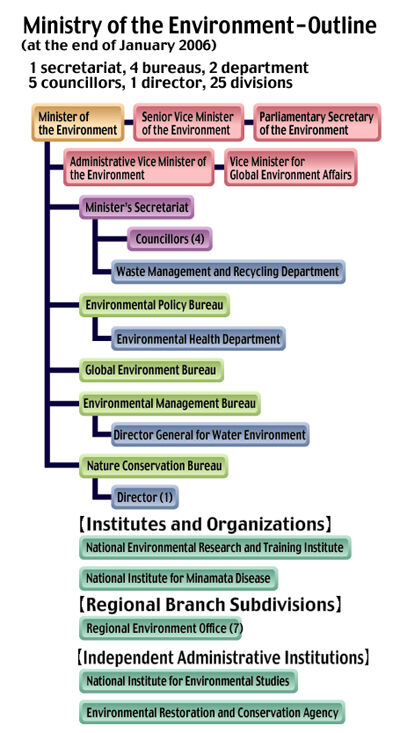
Picture 4.1 Organization of the Ministry of the Environment in Japan [2]
South Korea
The Ministry of Environment is the competent ministry in charge of environmental conservation and is responsible for formulating comprehensive environmental policies. As of July 2014, the main office of the Ministry of Environment consists of 527 officials, two departments, three bureaus, six offices, 37 divisions, two teams, and two task forces, as well as eight regional offices, associated subsidiaries, and affiliated public institutions. The key functions of the Ministry of Environment are to: (1) Establish a basic environmental administration system for enacting and amending environmental legislation, introducing environment-related schemes, and otherwise managing the national environment; (2) Formulate and enforce mid- and long-term comprehensive plans for environmental conservation; (3) Set various regulatory standards; (4) Provide administrative and financial support to regional environmental offices and local governments for environmental management; and (5) Cooperate with other countries regarding environmental conservation. The Planning and Coordination Department is in charge of administrative innovation, formulating key operation plans, budgeting, organizational management, environment information, and emergency plans. The International Cooperation Office consists of the International Affairs Division, in charge of international environmental cooperation, and the Global Environment Division, in charge of global environmental conservation. The Environmental Policy Department consists of the Environmental Policy Office, which is in charge of formulating comprehensive plans on environmental conservation, environmental technology development, environmental industries, environmental education, and environment-related cooperation with private organizations; the Environmental Health Policy Office, which is in charge of environmental health and management of hazardous chemicals, indoor air quality, noise, and other aspects of living environment management; and the Climate and Air Quality Policy Office, which is in charge of formulating air quality conservation policies, managing air pollutant-emitting establishments, vehicle pollution prevention, clean fuels, and climate change measures [13].
Organization of the Ministry of the Environment in South Korea is shown in the picture 4.2.

Picture 4.2 Organization of the Ministry of the Environment
in South Korea [13]
Russian Federation
The Ministry of Natural Resources and Environment (Minprirody) is a federal executive body responsible for drafting and implementing government policy and the legal regulation in the field of the exploration, use, reproduction and protection of natural resources, including mineral resources, water bodies, woodlands, animals and their habitats, and land relations concerned with the transfer of water and forest areas, as well as specially protected areas, territories and sites (as regards specially protected natural areas) to lands of other categories, in forestry relations, hunting, hydrometeorology and related sectors, environmental monitoring and protection, including radiation control regulation and monitoring, as well as developing and implementing the national policy and legal regulations in environment protection, including issues related to the treatment of industrial and consumer waste, specially protected natural territories, and state environmental expert evaluation.
Organization of the Ministry of Natural Resources and Environment in Russia is shown in the picture 4.3.

Picture 4.3 Organization of the Ministry of Natural Resources and Environment
in Russia [30]
Air pollution is one of the main risk factors for health related to the environment. By reducing levels of air pollution, countries can reduce the burden of diseases such as stroke, heart disease and lung cancer, as well as chronic and acute respiratory diseases, including asthma.
The lower the levels of air pollution, the better the cardiovascular and respiratory health of the population, both in the long term and in the short term.
The WHO Air Quality Guidelines contain an assessment of the health effects of air pollution and pollution thresholds that have a detrimental effect on health [31].
Health situation in Japan is shown in the picture 4.4 and 4.5.

Picture 4.4 Health systems in Japan [31]

Picture 4.5 Health situation and trends in Japan [31]
Health situation in South Korea is shown in the picture 4.6 and 4.7.

Picture 4.6 Health systems in South Korea [31]

Picture 4.7 Health situation and trends in South Korea [31]
-
Внедрение иностранного опыта охраны окружающей среды
в г. Хабаровске
Население Хабаровска – 611 160 человек (2016), площадь города – 386 км², плотность населения 1583,32 чел./км² [20].
Климат в Хабаровске – резко континентальный, несмотря на близость большой реки. Амур мало смягчает жару летом и не слишком увлажняет морозный воздух зимой. Летом – жара, которая вызывает лесные пожары. Гарь стоит во всем городе и практически не сдувается ветрами с реки, которых в это время практически нет.
Жара достигает 30-35 °С и держится около 2-3 недель. В остальные дни лета стоит обычное летнее тепло 25-30 °С. Часто идут грозы и меняется погода к вечеру. Периоды затяжных дождей коротки. Устойчивое тепло приходит в конце мая и длится до сентября. Июль – самый теплый месяц года, январь – самый холодный. Зимние температуры держатся в диапазоне от минус 20-25 °С до минус 40°С (редко), но часты ветра.
Количество солнечных дней до 300 в году. Это обусловлено господством зимой Сибирского антициклона, благодаря которому с ноября по март над городом устанавливается очень сухой и морозный континентальный воздух с ясной и солнечной погодой [20].
Загрязнения атмосферы от электроэнергетики составляют почти 27% всех промышленных отходов. В число городов, в которых в атмосферу уходит много отходов от сжигаемого в тепловых электростанциях топлива, входят такие города, как Ярославль, Хабаровск, Владивосток, Якутск.
Ещё 10 лет назад Хабаровск занимал место одного из городов с очень грязным атмосферным воздухом. По данным Росстата за 2013 год Хабаровск занимает 28 место в рейтинге самых экологически грязных городов России. Общий годовой объём выбросов – 96,6 тыс. тонн, 52,6 % из которых приходится на автомобили [32].
За 2015 год основной вклад в выбросы от стационарных источников внесли СП «Хабаровская ТЭЦ – 1» ОАО ДГК филиал «Хабаровская генерация», СП «Хабаровская ТЭЦ – 3» ОАО ДГК филиал «Хабаровская генерация», АО «ННК – Хабаровский нефтеперерабатывающий завод». Вклад автотранспорта в суммарный выброс составляет 49 % [33].
Это связано с тем, что:
– в российских автомобилях используется некачественное топливо;
– на российских дорогах еще много старых автомобилей, у которых плохая фильтрация выхлопов;
– российские автомобильные дороги мало приспособлены для передвижения большого количества автомобилей, в результате чего двигатель автомобиля работает не в оптимальном режиме и дает много выбросов.
Несмотря на засилье транспорта в городе и перегруженности основных артерий – а, отсюда, высокой загазованности, ветер с Амура немного помогает решить вопрос с загрязнением воздуха. Но периоды относительно чистого воздуха сменяются загазованностью в периоды штиля или изменения ветра. Окраины и места, отдаленные от реки, испытывают экологические проблемы, превышение нормы ПДК вредных веществ достигает там значения 2-3 ПДК.
В октябре 2015 года Rigma.info (новости Хабаровска и Хабаровского края) опубликовали статью с ссылкой на сайт Дальневосточного УГМС, в которой сказано, что по оценке синоптиков, в районе пересечения улиц Ленина и Калинина самый грязный воздух в Хабаровске. Содержание оксида углерода (СО) составляет 0,8 ПДК (предельно допустимая концентрация).
На втором месте по загрязненности воздуха идет район улиц Ленина-Фрунзе. Здесь оксид углерода доходит до значения 3,7 мг/м3.