ВКР Константинова К. К. (1190304), страница 10
Текст из файла (страница 10)
Table 4 Sales of top 10 Russian pharmaceutical companies in 2012, 2014, 2016
| № | The company | Sales in 2012, million dollars | Sales in 2014, million dollars | Sales in 2016, million dollars | The difference (2012/ 2014 г) % | The difference (2012/ 2016 г) % |
| 1 | Otcpharm | 348,6 | 332,5 | 270,8 | -4,6 | -22,3 |
| 2 | Pharmstandard | 187,3 | 200,2 | 150,8 | 6,9 | -19,5 |
| 3 | Akrikhin | 162,4 | 161,1 | 134,2 | -0,8 | -17,4 |
| 4 | Evalar | 124,2 | 123,1 | 72 | -0,9 | -42 |
| 5 | Microgen | 111,6 | 86,9 | 54,6 | -22 | -51,1 |
| 6 | Biocad | 67,5 | 63,3 | 175,4 | -6,2 | 159,9 |
| 7 | Vertex | 33 | 33,6 | 48,5 | 1,8 | 46,9 |
| 8 | Petrovax | 25,8 | 28,7 | 39,2 | 11,2 | 51,9 |
| 9 | R-Pharm | 14,1 | 20,2 | 21,8 | 43,2 | 54,6 |
| 10 | Biosintez | 7,5 | 9,6 | 8,6 | 28 | 14,7 |
In recent years, the domestic pharmaceutical market is experiencing a trend of sharp decline in sales of large Russian pharmaceutical companies, such as Otcpharm, Pharmstandard, Akrikhin, Evalar, Microgen, and stable and significant growth of small companies, occupying the last positions of the ranking – Biocad, Vertex, Petrovax, R-Pharm, Biosyntez. It should be noticed that the reason for this lower performance of large companies may be in an increase of dollar against the ruble, because of which materials and substances become more expensive. However, this did not prevent small pharmaceutical companies to embark on the path of development and a steady rise in sales.
Share of Russian production in the total volume of sales on the national pharmaceutical market traditionally makes up about 25% (2016 – 27,3%), it means that the market remains extremely importations.
The export of drugs from Russia is not as huge as import to Russia: export is 16 times less then import (figure 6).
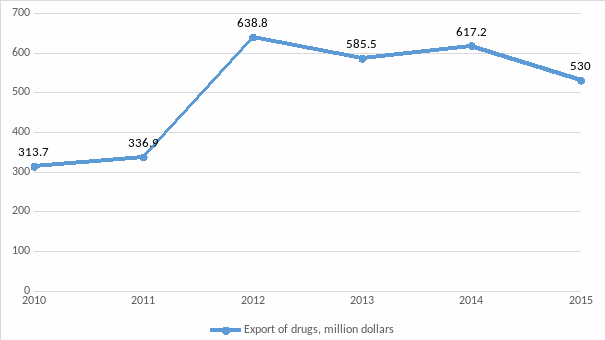
Figure 6 The export of Russian medicines
At the end of 2015, the volume of Russian exports of drugs accounted for 530 million dollars, which is 16% less than the previous year. In 2015, the Russian export of pharmaceutical products amounted to 0.12 percent of the global pharmaceutical export, which allowed Russia to take 39th place in the rating of countries-exporters of pharmaceutical products (36 in 2012).
The main importers of Russian products, consuming more than 65% of all Russian drugs, are Kazakhstan, Ukraine, Uzbekistan, Belarus and Georgia. The share of the top 10 importers accounted over 81% of total exports of pharmaceutical products (figure 7).
Figure 7 – The importers of Russian medicine
For the Russian pharmaceutical market following conclusions were made: a noticeable growth of the pharmaceutical market; a slight change in the market structure; the medicines import continues to increase, as the dependence from foreign pharmaceutical products; the export share is insignificant and has a tendency to decrease; state measures are used to support the Russian pharmaceutical manufacturers.
Companies of the pharmaceutical market competing use standard competitive strategies, which are suitable to all markets, adapting them to their business needs. Each company, studying the market, identifies the most significant factors, which have most influence on the company, on its activities and on its competitiveness. Then the company develops a strategy to improve the competitiveness of it’s business and a product, based on factors that are more important and which it can influence on. Next, we consider strategies and tools that foreign manufacturers of pharmaceutical products used to strengthen and improve its position in the global pharmaceutical market.
Experts divide these strategies, used by bid pharmaceutical companies and companies belonging to the group of Big Pharma, to the strategies with the participation of private capital and without (figure 8).
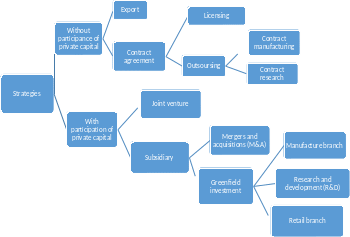
Figure 8 The most common strategies
About 72% of these strategies are strategies with participation of private capital, that means first, that the largest pharmaceutical companies prefer the high level of internal control over their business in the country, where it is situated, and second, the countries-recipients of capital have special laws for foreign pharmaceutical companies.
Among the strategies involving capital, mergers and acquisitions (M&A) strategies are dominating (40% of all involving capital strategies). Purchasing already existing business, the company gets some market share, skilled staff who understand the features of the country, the existing industrial and research division.
The example of such strategies can be the sale by the company of the Roche OTC business of the German company Bayer, which will benefit both companies – Roche has focused his efforts on a promising, in her view, directions and Bayer expanded its market share of OTC drugs.
Another example is Novartis: division of vaccines and veterinary medicine was given to the British company GlaxoSmithKline and the American Eli Lilly, respectively. Novartis bought GlaxoSmithKline’s Oncology range.
Widespread also get such types of expansion, as a strategy of joint ventures in international cooperation, more than 20% of implemented strategies with the participation capital were associated with R & d investment.
If we consider international collaboration of pharmaceutical companies, there are many forms of it. From joint workshops and conferences for consumers and doctors to creating joint ventures and scientific research in any field of the pharmaceutical business.
Examples of international cooperation are the purchase of the German company Boehringer Ingelheim Sanofi the French veterinary business of the company for 12.8 billion USD in exchange for (Business swap) its OTC division. Example of international cooperation of the large number of companies is, for example, the 21st Dubai International Pharmaceuticals and technologies conference and exhibition – DUPHAT, which was attended by more than 50 pharmaceutical companies from around the world. One of the major examples of international pharmaceutical cooperation is the creation of two of the world's largest pharmaceutical companies, the Swiss Novartis and British GlaxoSmithKline (GSK), a joint venture for OTC drugs.
R & d investments are important in maintaining the competitiveness of the pharmaceutical drugs. After all, the new technology, a new vaccine, a new drug is the key to strengthen the position on the pharmaceutical market or the creation of a new direction, a new niche in the pharmaceutical industry.
The experience of foreign companies should become for Russian pharmaceutical manufacturers an example that should be explored and highlight suitable strategies enhancing competitiveness on the national and then the global pharmaceutical market.
The analysis of competitive strategies used by Russian pharmaceutical companies was conducted. The research identified several strategies, which are the most frequently used by Russian pharmaceutical manufacturers.
The strategy of "squeezing residues". Such enterprises have outdate production capacity, existing since the Soviet times, produce all known obsolete, but at the same time have strong demand for inexpensive medications (e.g., aspirin, validol etc.). The profitability of the company is provided by the traditional consumption of drugs, the sale of which requires no efforts to development. Examples of companies applying this strategy are the company Akrikhin and Pharmstandard. The strategy of "squeezing residues" is not suitable for domestic pharmaceutical manufacturers. This strategy does not imply development, just squeezing the last benefits of what has been successful long time ago. If the company wants to increase its competitiveness, increase its influence, market share, stimulate demand for its products, it is first necessity to begin with the renewal of old Soviet equipment, widering of assortment of medicines, import the technology from abroad. For the company, which currently follows a strategy of "squeezing residues" other strategies such as "copy" or "cooperation” can be effective. They will allow at the first time to move away from old traditions of production, outdated equipment and the assortment and to focus their activities on development.
The strategy of "cooperation". Based on the interaction with leading Western pharmaceutical manufacturers. It can be packaging in Russia, tableting production of finished drug substance, etc. On such plants are relatively modern equipment for packing and packaging of finished dosage forms, largely due to the high quality requirements of finished products imposed by foreign pharmaceutical companies. A striking example of this strategy is the company STADA CIS, which combines the German STADA AG and the Russian Nizhpharm, Makizpharm and Hemofarm. The strategy of "cooperation" is not so common in Russian practice, comparing to the global pharmaceutical market. Foreign companies often merge or absorb the Russian pharmaceutical companies, or open their own representative office on the territory of the country. Due to the weak development of technology, inefficient intellectual property protection, difficulties in the interpretation of the Russian law, foreign companies see a risk in the joint venture. For the Russian pharmaceutical companies, this practice could be the route for development and increasing their competitiveness on the domestic market, and subsequently in foreign markets. "Cooperation" has a positive side for domestic manufacturers of pharmaceutical products: knowledge exchange, import of technologies, training and retraining of managers and staff, enhancing its own reputation at the expense of the successful international pharmaceutical company, internship opportunities for employees in leading pharmaceutical companies, joint research and development. There is a risk of poaching staff from foreign pharmaceutical company, but in general this strategy is the most suitable for Russian companies, because in addition to these positive aspects, still implies a smaller investment of resources than creating a new branch or a single research and development.
The strategy of "copying". Used by companies producing generics of the penultimate and the last generation. At such plants are relatively modern equipment of a full cycle, allowing to produce products that can compete with generic drugs of foreign production. This strategy is one of the most promising directions of development of Russian pharmaceutical enterprises. In addition, the strategy used by the majority of Russian pharmaceutical companies: Otcpharm, Vertex, Petrovax, Evalar, Biosynthes, Biocad and others. If talking about the output of these companies into foreign markets, it can be successful in the CIS, where the Russian drugs and pharmaceutical companies have a good reputation, but the expansion of the CIS countries will require greater effort. The output of the Russian generic companies does not allow to satisfy the demand in the domestic market completely, so exporting doesn’t make any sense. This is needed in the future to expand production, to increase the range of manufactured of dzhenerikov, explore overseas markets, legislation to expand the logistics network, to develop a marketing strategy for creating demand for Russian jeneriki. Only after these steps, you will start to go on the pharmaceutical market of CIS countries, and it is better to start will be with the direct or indirect export, in order to understand the country's need for medicines of the Russian manufacture.
The strategy of "breakthrough". The company offers the original drugs without analogs. For the production of such drugs, the company can use its own production facilities and place orders for production in other enterprises with the necessary production capacity. This strategy is very unpopular among Russian pharmaceutical manufacturers. There is no company that is completely focused its activities on development. However, many companies create departments for research and development as an addition to main activity. The greatest success in this strategy the company Biocad have made. This will not only increase the competitiveness of pharmaceutical companies, but in general achievement of the development of production of medicines, research and development. In the long term that will increase the competitiveness of the industry and advanced training of employees of the pharmaceutical industry, and the success of development and innovation, and on the inflow of capital in Russian pharmaceutical company.
Next it is necessary to look through strategies for improving the competitiveness of foreign manufacturers of pharmaceutical products and to evaluate the possibility of using it for Russian pharmaceutical companies. The most common strategies used by global pharmaceutical companies, include mergers and acquisitions (M&A), joint ventures in the framework of international cooperation and investment in research and development.