debugDDe (1158408), страница 2
Текст из файла (страница 2)
The following structure is defined for the table:
| typedef struct tag_TABLE | ||||
| { | ||||
| byte | IsInit; | |||
| s_COLLECTION | cTable; | |||
| size_t | TableSize; | |||
| size_t | CurSize; | |||
| size_t | ElemSize; | |||
| PFN_TABLE_ELEMDESTRUCTOR | Destruct; | |||
| } | TABLE; | |||
| IsInit | – | flag of the table initialization. It is used for postponed initialization improve performance. | ||
| cTable | – | a set of pointers to allocated memory blocks | ||
| TableSize | – | number of elements to allocate when the table is expanded | ||
| CurSize | – | number of used elements in the current table block | ||
| ElemSize | – | size in bytes of one element | ||
| Destruct | – | pointer to the function with prototype void (*PFN_TABLE_ELEMDESTRUCTOR)(void *Elem). This function is called for each table element when it is removed from the table. | ||
The following calls are intended for work with the table:
| void table_Init(TABLE *tb, size_t TableSize, size_t ElemSize, PFN_TABLE_ELEMDESTRUCTOR Destruct) | ||
| tb | – | pointer to the TABLE structure to be initialized. |
| TableSize | – | number of the elements to allocate when expanding the table |
| ElemSize | – | size in bytes of one table element |
| Destuct | – | pointer to table element destructor function. It can be NULL. |
Table initialization. This function should be called before using the table.
| void table_Done( TABLE *tb ) | ||
| tb | – | pointer to the TABLE structure. |
Table destructor. This function should be called upon usage of the table to free allocated memory. It calls element destructor for each element of the table.
| long table_Count( TABLE *tb ) | ||
| tb | – | pointer to the TABLE structure. |
The function returns number of used table elements.
| void *table_At( TABLE *tb, long No ) | ||
| tb | – | pointer to the TABLE structure. |
| No | – | zero based element number. The program will aborted if the No does not fall to number of elements range |
The function returns the pointer to the specified table element.
| long table_Put( TABLE *tb, void *Struct ) | ||
| tb | – | pointer to the TABLE structure. |
| Struct | – | pointer to the inserted element. Only ElemSize bytes will be copied into the table |
The function inserts a new element into the table.
| void *table_GetNew( TABLE *tb ) | ||
| tb | – | pointer to the TABLE structure. |
The function inserts allocates a space for new element into the table and returns a pointer to this element. The function is more effective then table_Put() because no memory copy operation is performed.
| void table_RemoveFrom( TABLE *tb, long Index ) | ||
| tb | – | pointer to the TABLE structure. |
| Index | – | element number from which elements will be removed. |
The function removes elements of the table starting from number Index. The element with the number Index itself remains in the table.
| void table_RemoveAll( TABLE *tb ) | ||
| tb | – | pointer to the TABLE structure. |
The function removes all elements from the table and frees allocated memory.
| void table_Iterator(TABLE *tb, PFN_TABLEITERATION Proc, void *Param1, void *Param2) | ||
| tb | – | pointer to the TABLE structure. |
| Proc | – | iteration function with the following prototype: void (*PFN_TABLEITERATION)( void *Elem, void *Param1, void *Param2 ). This function will be called for each element of the table |
| Param1 | – | the parameter passed as Param1 into the Proc function |
| Param2 | – | the parameter passed as Param2 into the Proc function |
The function applies the same operation to each element of the table.
4.2Hash-table
The hash-table is intended to store elements of long type accessed by a key. The hash-table is organized as a table of fixed size. All elements with the same hash-value are put to a chain that is associated with the hash-value. When an element is searched, the hash-value is calculated using the key, and then each element of the corresponding chain is examined.
The hash-table consists of two parts: a hash-index and a hash-array keeping keys and associated values. The following steps are performed to find the specified value using a key. The hash-value is calculated using the key. The element of the hash-index determined by the hash-value is extracted. The element contains an element number in the hash-array. This hash-array element starts the chain of elements with the same hash-value. Each element of the hash-array has NextElem field that refers to the next chain element. The zero value of this field means the end of the chain. While elements are searched, the key field of the elements is compared with the specified key. If the keys are matched, the value of the Assign field is returned as result of the search.
The following algorithms can be used to calculate hash-values:
-
StandartHashCalc. The following function is used: HASH-VALUE = (long)Key % HashIndexSize, where Key is the element's key, HashIndexSize is the size of the hash-index, % is operator to take the reminder of integral division.
-
OffsetHashCalc. The following function is used: HASH-VALUE = ((long)Key >> Offset)% HashIndexSize, where Key is the element's key, HashIndexSize is the size of the hash-index, Offset is an offset specified as parameter, % is operator to take the reminder of integral division, and >> is shift right operator. If Offset = 0, this algorithm is identical to StandartHashCalc.
The following picture schematically shows realization of hash-table:
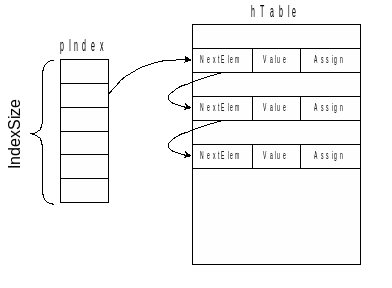
Figure 1. Foundation of hash-table
The following types are defined for the hash-table:
Hash-value:
| typedef size_t HASH_VALUE |
Key value:
| typedef unsigned long STORE_VALUE |
Structure of the hash-table element:
| typedef struct tag_HashList | ||||
| { | ||||
| long | NextElem; | |||
| STORE_VALUE | Value; | |||
| long | Assign; | |||
| } | HashList; | |||
| NextElem | – | the number of the next chain element. It is equal to zero for the last chain element. | ||
| Value | – | the element key. This key is used to access to the element | ||
| Assign | – | the stored value | ||
Structure of the hash-table:
| typedef struct tag_HASH_TABLE | ||||
| { | ||||
| TABLE | hTable; | |||
| long * | pIndex; | |||
| size_t | IndexSize; | |||
| PFN_CALC_HASH_FUNC | HashFunc; | |||
| unsigned long * | pElements; | |||
| unsigned long | statCompare, statPut, statFind; | |||
| } | HASH_TABLE; | |||
| hTable | – | the hash-array of hash-table elements. The hash-array is organized as a table structure. | ||
| pIndex | – | the hash-index, an array containing starting indexes of the chains. The hash-value gives an index in the hash-index. | ||
| IndexSize | – | size of the pIndex array. | ||
| HashFunc | – | pointer to the function that calculates a hash-value by a key. | ||
| pElements | – | array that keeps chain sizes of corresponding pIndex elements. It is used to store statistics of using hash-table elements. | ||
| statCompare, statPut, statFind | – | statistics fields. These fields contain count of ‘compare’, ‘put’ and ‘find’ actions performed with the hash-table. | ||
The following functions are intended for working with hash-table:
| void hash_Init(HASH_TABLE *HT, size_t IndexSize, int TableSize, PFN_CALC_HASH_FUNC Func) | ||
| HT | – | pointer to HASH_TABLE structure to be initialized. |
| IndexSize | – | the size of the hash-index |
| TableSize | – | hash-array increment value for hash-array expansion. |
| Func | – | pointer to the function that calculates hash-value. If Func is, equal to NULL then the standard function StandartHashCalc will be applied. The function StandartHashCalc calculates hash-value using the following formula: <hash-value> = <key> % IndexSize. |
The function performs all required initialization operations for hash-table.
| void hash_Done( HASH_TABLE *HT ) | ||
| HT | – | pointer to the HASH_TABLE structure. |
The function uninitializes the hash-table. The function frees all allocated memory for hash-table elements.
| long hash_Find( HASH_TABLE *HT, STORE_VALUE Val ) | ||
| HT | – | pointer to the HASH_TABLE structure. |
| Val | – | the key of the element. |
The function finds a value by the specified key.
| void hash_Insert( HASH_TABLE *HT, STORE_VALUE Val, long Assign ) | ||
| HT | – | pointer to the HASH_TABLE structure. |
| Val | – | the key of inserted element. |
| Assign | – | the value associated with the key. |
The function inserts a new element into the hash-table.
| void hash_Change( HASH_TABLE *HT, STORE_VALUE Val, long Assign ) | ||
| HT | – | pointer to the HASH_TABLE structure. |
| Val | – | the key of changed element. |
| Assign | – | the value associated with the key. |
The function updates an associated value for the specified key.
| void hash_Remove( HASH_TABLE *HT, STORE_VALUE Val ) | ||
| HT | – | pointer to the HASH_TABLE structure. |
| Val | – | the key of removed element. |
the function removes an element with the specified key.
| void hash_Iterator(HASH_TABLE *HT, PFN_HASHITERATION Proc, void *Param) | ||
| HT | – | pointer to the HASH_TABLE structure. |
| Proc | – | iteration function with the following prototype: void (*PFN_HASHITERATION)(long Elem, void *Param) where Elem is associated value of a hash-table element and Param is additional parameter. This function will be called for each hash-table element. |
| Param | – | parameter passed as Param into the Proc function |
The function applies the same operation for all the hash-table elements.
| void hash_RemoveAll( HASH_TABLE *HT ) | ||
| HT | – | pointer to the HASH_TABLE structure. |
The function removes all elements from the hash-table.
4.3Table of variables
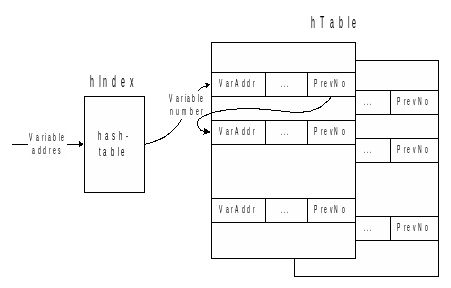
The table of variables is intended to store information about variables and to fast access to it using the variable address.
Each element of a table of variables keeps the reference to the same variable at the previous level (if the variable is used at several levels), address of variable, class of using, and additional information that depends on class of using.