glm (1125871), страница 3
Текст из файла (страница 3)
Figure 4.10.1: glm::vec4(glm::linearRand(glm::vec2(-1), glm::vec2(1)), 0, 1);

Figure 4.10.2: glm::vec4(glm::circularRand(1.0f), 0, 1);

Figure 4.10.3: glm::vec4(glm::sphericalRand(1.0f), 1);

Figure 4.10.4: glm::vec4(glm::diskRand(1.0f), 0, 1);

Figure 4.10.5: glm::vec4(glm::ballRand(1.0f), 1);

Figure 4.10.6: glm::vec4(glm::gaussRand(glm::vec3(0), glm::vec3(1)), 1);
4.11. GLM_GTC_reciprocal
Provides hyperbolic functions: secant, cosecant, cotangent, etc.
<glm/gtc/reciprocal.hpp> need to be included to use these functionalities.
4.12. GLM_GTC_swizzle
Provide functions to emulate GLSL swizzle operator features but with a different syntax that feats C++ boundaries.
<glm/gtc/swizzle.hpp> need to be included to use these functionalities.
4.13. GLM_GTC_type_precision
Vector and matrix types with defined precisions. Eg, i8vec4: vector of 4 signed integer of 8 bits.
<glm/gtc/type_precision.hpp> need to be included to use these functionalities.
4.14. GLM_GTC_type_ptr
Handles the interaction between pointers and vector, matrix types.
This extension defines an overloaded function, glm::value_ptr, which takes any of the core template types (vec3, mat4, etc.). It returns a pointer to the memory layout of the object. Matrix types store their values in column-major order.
This is useful for uploading data to matrices or copying data to buffer objects.
Example:
#include <glm/glm.hpp>
#include <glm/gtc/type_ptr.hpp>
glm::vec3 aVector(3);
glm::mat4 someMatrix(1.0);
glUniform3fv(uniformLoc, 1, glm::value_ptr(aVector));
glUniformMatrix4fv(uniformMatrixLoc,
1, GL_FALSE, glm::value_ptr(someMatrix));
<glm/gtc/type_ptr.hpp> need to be included to use these features.
4.15. GLM_GTC_ulp
Allow the measurement of the accuracy of a function against a reference implementation. This extension works on floating-point data and provides results in ULP.
<glm/gtc/ulp.hpp> need to be included to use these features.
5. Known issues
5.1. not function
The GLSL keyword not is also a keyword in C++. To prevent name collisions, ensure cross compiler support and a high API consistency, the GLSL not function has been implemented with the name not_.
5.2. half based types and component accesses
GLM supports half float number types through the extension GLM_GTC_half_float. This extension provides the types half, hvec*, hmat*x* and hquat*.
Unfortunately, C++98 specification doesn’t support anonymous unions which limits hvec* vector components access to x, y, z and w.
However, Visual C++ does support anonymous unions if the language extensions are enabled (/Za to disable them). In this case GLM will automatically enables the support of all component names (x,y,z,w ; r,g,b,a ; s,t,p,q).
To uniformalize the component access across types, GLM provides the define GLM_FORCE_ONLY_XYZW which will generates errors if component accesses are done using r,g,b,a or s,t,p,q.
#define GLM_FORCE_ONLY_XYZW
#include <glm/glm.hpp>
6. FAQ
6.1 Why GLM follows GLSL specification and conventions?
Following GLSL conventions is a really strict policy of GLM. It has been designed following the idea that everyone does its own math library with his own conventions. The idea is that brilliant developers (the OpenGL ARB) worked together and agreed to make GLSL. Following GLSL conventions is a way to find consensus. Moreover, basically when a developer knows GLSL, he knows GLM.
6.2. Does GLM run GLSL program?
No, GLM is a C++ implementation of a subset of GLSL.
6.3. Does a GLSL compiler build GLM codes?
No, this is not what GLM attends to do!
6.4. Should I use ‘GTX’ extensions?
GTX extensions are qualified to be experimental extensions. In GLM this means that these extensions might change from version to version without any restriction. In practice, it doesn’t really change except time to time. GTC extensions are stabled, tested and perfectly reliable in time. Many GTX extensions extend GTC extensions and provide a way to explore features and implementations and APIs and then are promoted to GTC extensions. This is fairly the way OpenGL features are developed; through extensions.
6.5. Where can I ask my questions?
A good place is the OpenGL Toolkits forum on OpenGL.org
6.6. Where can I find the documentation of extensions?
The Doxygen generated documentation includes a complete list of all extensions available. Explore this API documentation to get a complete view of all GLM capabilities!
6.7. Should I use ‘using namespace glm;’?
NO! Chances are that if ‘using namespace glm;’ is called, especially in a header file, name collisions will happen as GLM is based on GLSL which uses common tokens for types and functions. Avoiding ‘using namespace glm;’ will a higher compatibility with third party library and SDKs.
6.8. Is GLM fast?
First, GLM is mainly designed to be convenient and that's why it is written against GLSL specification. Following the 20-80 rules where 20% of the code grad 80% of the performances, GLM perfectly operates on the 80% of the code that consumes 20% of the performances. This said, on performance critical code section, the developers will probably have to write to specific code based on a specific design to reach peak performances but GLM can provides some descent performances alternatives based on approximations or SIMD instructions.
6.9. When I build with Visual C++ with /W4 warning level, I have warnings...
You should not have any warnings even in /W4 mode. However, if you expect such level for you code, then you should ask for the same level to the compiler by at least disabling the Visual C++ language extensions (/Za) which generates warnings when used. If these extensions are enabled, then GLM will take advantage of them and the compiler will generate warnings.
7. Code samples
This series of samples only shows various GLM features without consideration of any sort.
7.1. Compute a triangle normal
#include <glm/glm.hpp> // vec3 normalize cross
glm::vec3 computeNormal
(
glm::vec3 const & a,
glm::vec3 const & b,
glm::vec3 const & c
)
{
return glm::normalize(glm::cross(c - a, b - a));
}
// A much faster but less accurate alternative:
#include <glm/glm.hpp> // vec3 cross
#include <glm/gtx/fast_square_root.hpp> // fastNormalize
glm::vec3 computeNormal
(
glm::vec3 const & a,
glm::vec3 const & b,
glm::vec3 const & c
)
{
return glm::fastNormalize(glm::cross(c - a, b - a));
}
7.2. Matrix transform
// vec3, vec4, ivec4, mat4
#include <glm/glm.hpp>
// translate, rotate, scale, perspective
#include <glm/gtc/matrix_transform.hpp>
// value_ptr
#include <glm/gtc/type_ptr.hpp>
void setUniformMVP
(
GLuint Location,
glm::vec3 const & Translate,
glm::vec3 const & Rotate
)
{
glm::mat4 Projection =
glm::perspective(45.0f, 4.0f / 3.0f, 0.1f, 100.f);
glm::mat4 ViewTranslate = glm::translate(
glm::mat4(1.0f),
Translate);
glm::mat4 ViewRotateX = glm::rotate(
ViewTranslate,
Rotate.y, glm::vec3(-1.0f, 0.0f, 0.0f));
glm::mat4 View = glm::rotate(
ViewRotateX,
Rotate.x, glm::vec3(0.0f, 1.0f, 0.0f));
glm::mat4 Model = glm::scale(
glm::mat4(1.0f),
glm::vec3(0.5f));
glm::mat4 MVP = Projection * View * Model;
glUniformMatrix4fv(Location, 1, GL_FALSE, glm::value_ptr(MVP));
}
7.3. Vector types
#include <glm/glm.hpp> //vec2
#include <glm/gtc/type_precision.hpp> //hvec2, i8vec2, i32vec2
std::size_t const VertexCount = 4;
// Float quad geometry
std::size_t const PositionSizeF32 = VertexCount * sizeof(glm::vec2);
glm::vec2 const PositionDataF32[VertexCount] =
{
glm::vec2(-1.0f,-1.0f),
glm::vec2( 1.0f,-1.0f),
glm::vec2( 1.0f, 1.0f),
glm::vec2(-1.0f, 1.0f)
};
// Half-float quad geometry
std::size_t const PositionSizeF16 = VertexCount * sizeof(glm::hvec2);
glm::hvec2 const PositionDataF16[VertexCount] =
{
glm::hvec2(-1.0f, -1.0f),
glm::hvec2( 1.0f, -1.0f),
glm::hvec2( 1.0f, 1.0f),
glm::hvec2(-1.0f, 1.0f)
};
// 8 bits signed integer quad geometry
std::size_t const PositionSizeI8 = VertexCount * sizeof(glm::i8vec2);
glm::i8vec2 const PositionDataI8[VertexCount] =
{
glm::i8vec2(-1,-1),
glm::i8vec2( 1,-1),
glm::i8vec2( 1, 1),
glm::i8vec2(-1, 1)
};
// 32 bits signed integer quad geometry
std::size_t const PositionSizeI32 = VertexCount * sizeof(glm::i32vec2);
glm::i32vec2 const PositionDataI32[VertexCount] =
{
glm::i32vec2(-1,-1),
glm::i32vec2( 1,-1),
glm::i32vec2( 1, 1),
glm::i32vec2(-1, 1)
};
7.4. Lighting
#include <glm/glm.hpp> // vec3 normalize reflect dot pow
#include <glm/gtx/random.hpp> // vecRand3
// vecRand3, generate a random and equiprobable normalized vec3
glm::vec3 lighting
(
intersection const & Intersection,
material const & Material,
light const & Light,
glm::vec3 const & View
)
{
glm::vec3 Color = glm::vec3(0.0f);
glm::vec3 LightVertor = glm::normalize(
Light.position() - Intersection.globalPosition() +
glm::vecRand3(0.0f, Light.inaccuracy());
if(!shadow(
Intersection.globalPosition(),
Light.position(),
LightVertor))
{
float Diffuse = glm::dot(Intersection.normal(), LightVector);
if(Diffuse <= 0.0f)
return Color;
if(Material.isDiffuse())
Color += Light.color() * Material.diffuse() * Diffuse;
if(Material.isSpecular())
{
glm::vec3 Reflect = glm::reflect(
-LightVector,
Intersection.normal());
float Dot = glm::dot(Reflect, View);
float Base = Dot > 0.0f ? Dot : 0.0f;
float Specular = glm::pow(Base, Material.exponent());
Color += Material.specular() * Specular;
}
}
return Color;
}
8. References
8.1. GLM development
- GLM website
- GLM HEAD snapshot
- GLM bug report and feature request
- G-Truc Creation’s page
8.2. OpenGL specifications
- OpenGL 4.3 core specification
- GLSL 4.30 specification
- GLU 1.3 specification
8.3. External links
- The OpenGL Toolkits forum to ask questions about GLM
8.4. Projects using GLM
- Outerra:
3D planetary engine for seamless planet rendering from space down to the surface. Can use arbitrary resolution of elevation data, refining it to centimeter resolution using fractal algorithms.




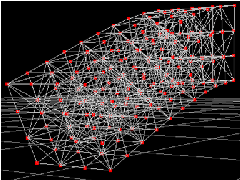
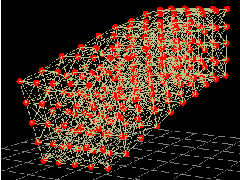
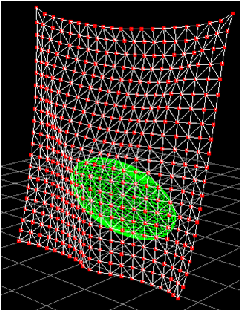
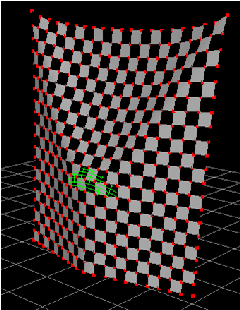
- opencloth:
A collection of source codes implementing cloth simulation algorithms in OpenGL.
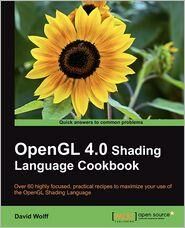
- OpenGL 4.0 Shading Language Cookbook:
| A full set of recipes demonstrating simple and advanced techniques for producing high-quality, real-time 3D graphics using GLSL 4.0. How to use the OpenGL Shading Language to implement lighting and shading techniques. Use the new features of GLSL 4.0 including tessellation and geometry shaders. How to use textures in GLSL as part of a wide variety of techniques from basic texture mapping to deferred shading. Simple, easy-to-follow examples with GLSL source code, as well as a basic description of the theory behind each technique. |
|
- Are you using GLM in a project?
8.5. OpenGL tutorials using GLM
- The OpenGL Samples Pack, samples that show how to set up all the different new features
- Learning Modern 3D Graphics Programming, a great OpenGL tutorial using GLM by Jason L. McKesson
- Morten Nobel-Jørgensen’s review and use an OpenGL renderer

















