Digital flux gate magnetometer (992980)
Текст из файла
.
гр. А-15-0
Flux-gate magnetometer with drive signal for reducing effects of electromagnetic
interference
Феррозондовый преобразователь с возбуждающим сигналом для уменьшения эффекта электромагнитной интерференции.
Abstract of US6268725
A flux-gate magnetometer having a drive signal for reducing the effects of electromagnetic interference (EMI) is provided. The drive signal has a characteristic that varies over time. For example, the drive signal may include a duty cycle that varies over time, the frequency of the drive signal may be varied over time, or the phase shift of the drive signal may vary over time.
Выдержка из US6268725
Предусматривается феррозондовый преобразователь, имеющий возбуждающий сигнал, позволяющий уменьшить эффект электромагнитной интерференции (ЭМИ). Возбуждающий сигнал имеет характеристику, изменяющуюся во времени. Например, возбуждающий сигнал может содержать нагрузку, которая изменяется во времени, сама частота возбуждающего сигнала может варьироваться во времени или сдвиг фазы возбуждающего сигнала может изменяться во времени.
BACKGROUND OF THE INVENTION
Flux-gate magnetometers have significant advantages in size, weight, power consumption, and reliability for use in the measurement of magnetic fields, particularly small magnetic fields. Generally, a flux-gate magnetometer includes one or more sensors which include a magnetizable core and at least one coil wound around the core. The flux-gate magnetometer senses the magnetic field by stimulating the sensor with a known signal. The known signal is used to drive the core in and out of saturation. The nonlinear magnetic properties of the core cause the second harmonic of the frequency of the known drive signal to be generated. The magnitude of the external magnetic field, i.e., the magnetic field to be measured, is proportional to or can be determined as a function of the second harmonic. For example, in the absence of any component of an external magnetic field, the peaks detected in an output voltage generated across a sensor of the flux-gate magnetometer may be uniform. On the other hand, in the presence of an external magnetic field, the voltage peaks may vary in a manner which may be measured by applying the output voltage to signal conditioning circuitry so as to provide a measurement signal representative of the external magnetic field to be measured.
In other words, the measurement of the external magnetic field is performed through modulation of a core of variable permeability. The modulated field is detected with the coil wound about the core. A change in permeability is accomplished with the known drive signal, e.g., drive current, in the coil wound about the core in such a fashion as to saturate the core during part of the cycle of the drive waveform. Modulation of the magnetic field to be sensed occurs only at even harmonics of the drive waveform due to the symmetry of the magnetization curve. Generally, the second harmonic is used as the measure of the external magnetic field.
Problems may occur in flux-gate magnetometers if operated in high noise environments, e.g., such as in an automobile or around other noisy equipment producing EMI. For example, if the frequency of the EMI is twice that of the drive signal, i.e., equal to the second harmonic frequency, the EMI will be undesirably sensed by the sensor(s) and interpreted as all or a part of an external magnetic field.
In the past, differential circuitry has been used to reduce the effects of EMI. For example, such differential techniques may involve the use of two sensors oriented opposite to one another in a magnetic field to be measured such that one sensor would provide a second harmonic signal which is inverted with respect to the other sensor. Using subtraction of the two signals, noise which is common to both of the sensors (i.e., common mode noise) can be canceled. However, in high noise environments, such differential circuit techniques do not provide adequate EMI immunity.
Conventionally, the drive signal used for driving the core in and out of saturation is a periodic and repetitive drive signal. For example, drive signals which have been used in the past to drive the sensors in and out of saturation include repetitive and periodic triangular waveforms and other repetitive and periodic waveforms, such as those waveforms having a constant duty cycle and/or a constant frequency over time. Flux-gate magnetometers are well known in the art, some examples of which may be found in the issued patents and references listed in Table 1 below.
Предпосылки для изобретения.
Феррозондовый магнитометр имеет значительное преимущество по размеру, весу, энергопотреблению и надежности при использовании его для измерения магнитных полей, особенно малых полей. Как правило, феррозонд содержит один или два датчика, в которые входит намагничивающийся сердечник и, по крайней мере, одна катушка, обвитая вокруг сердечника. Феррозонд чувствует магнитное поле благодаря возбуждению в датчике известного сигнала. Этот сигнал используется для введение и выведения сердечника в и из насыщения. Нелинейная магнитная характеристика материала сердечника порождает вторую гармонику в известном возбуждающем сигнале. Амплитуда внешнего магнитного поля пропорциональна этой второй гармонике. Например, при отсутствии одной из компонент внешнего магнитного поля максимум выходного напряжения феррозондового датчика может не изменяться. С другой стороны в присутствии внешнего магнитного поля максимум выходного напряжения может изменяться так, что его можно измерить путем наложения на известный сигнал.
Другими словами, измерение внешнего поля производится путем модуляции магнитной проницаемости материала сердечника. Модулируемое поле детектируется катушкой на сердечнике. Изменение магнитной проницаемости достигается с помощью известного возбуждающего сигнала, например, тока в катушке, намотанной на сердечник, чтобы насытить сердечник до определенной степени в течение длительности возбуждающего сигнала. Модуляция искомого магнитного поля происходит только в четных гармониках возбуждающего сигнала из-за симметрии кривой намагничивания. Как правило, для измерений используется вторая гармоника.
При работе феррозонда в среде с большими помехами могут возникнуть затруднения, например, в автомобиле или любой другой сильно шумящей среде, создающей ЭМИ. Например, если частота ЭМИ вдвое больше частоты возбуждающего сигнала, т.е. совпадает со второй гармоникой, то ЭМИ будет хорошо фиксироваться датчиками и интерпретироваться как часть измеряемого магнитного поля.
Раньше для уменьшения влияния ЭМИ использовались дифференциальные схемы. Например, такая схема может быть основана на использовании двух противоположно ориентированных в измеряемом магнитном поле преобразователях, так чтобы вторая гармоника первого датчика являлась бы инверсной по отношению ко второму датчику. При использовании разности двух сигналов, шум, который одинаков для обоих датчиков, может быть исключен. Однако в сильно шумящих средах такая дифференциальная схема не обеспечивает достаточную защиту от ЭМИ.
Обычно возбуждающий сигнал, используемый для насыщения сердечника датчика, был периодически повторяющимся. Например, возбуждающий сигнал, который использовался ранее, имел треугольную или другие периодически повторяющиеся формы и имел постоянный рабочий чикл (постоянную нагрузку?) и/или не изменяющуюся во времени частоту. Сами феррозонды уже хорошо известны и вот несколько запатентованных ранее примеров с их использованием: № 3,638,074 и № 5,530,349.
SUMMARY OF THE INVENTION
The present invention has certain objects. That is, various embodiments of the present invention provide solutions to one or more problems existing in the prior art with respect to the effects of EMI on flux-gate magnetometers. Such problems are present when flux-gate magnetometers are used in a high noise environment, such as in automobiles or around other equipment that generates noise. For example, if the frequency of EMI in the environment is twice that of the drive signal for the flux-gate magnetometer, the EMI will be sensed by the sensor(s) of the magnetometer and undesirably be interpreted as an external magnetic field. As such, inaccuracies in the measurement of external magnetic fields to be measured will result. While differential circuitry reduces the effects of EMI for flux-gate magnetometers in noisy environments, the reduction is inadequate for the high sensitivity desired for many magnetometer applications.
In comparison to known techniques for reducing EMI effects in flux-gate magnetometers, various embodiments of the present invention provide for further reduction in the effect of EMI on magnetic field measurement. The various embodiments of the present invention may provide one or more of the following advantages: allow the detection of very small magnetic fields in a very high noise environment; provide for further EMI immunity in a noisy environment when combined with the use of differential circuits; provide for a second harmonic signal that would not likely be followed by EMI in the noisy environment, and reduce EMI emissions. ↓
В сравнении с известными технологиями уменьшения эффекта ЭМИ в феррозондовых преобразователях различные модификации настоящего изобретения позволяют еще более снизить этот эффект при измерении магнитных полей. Вот какие преимущества: можно детектировать очень малые магнитные поля в очень сильно шумящей среде; возможность дополнительного снижения влияния ЭМИ в среде с высоким шумом при использовании дифференциальных схем; предусматривает вторую гармонику в сигнале при маловероятном влиянии ЭМИ и снижает ЭМИ эмиссию.
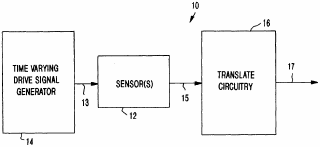
Some embodiments of the invention include one or more of the following features: a drive signal generator operatively connected to drive one or more sensors of a flux-gate magnetometer, wherein the drive signal has a characteristic that varies over time; a drive signal that has a characteristic that is pseudo-randomly varied over time (e.g., a duty cycle of the signal that pseudo-randomly varies over time, a frequency that varies over time, or phase shift that varies over time); a drive signal that has a frequency that varies over time; a drive signal that has a frequency that is non-randomly varied over time such as a frequency varied over time in a predetermined pattern, e.g., not in a pseudo-random manner; translation circuitry operatively connected to sensor(s) of a flux-gate magnetometer to provide a measurement output representative of the external magnetic field based on the output from one or more sensors of a flux-gate magnetometer; differential circuitry for canceling common mode noise present at multiple sensors of a flux-gate magnetometer; a drive signal generator that includes a triangle wave oscillator having a controllable capacitance, wherein the controllable capacitance is used to vary the frequency of a triangle wave drive signal over time (e.g., introduce time jitter into the drive signal); and/or a drive signal generator that includes a triangle wave oscillator having a controllable current, wherein the controllable current is used to vary the frequency of a triangle wave drive signal over time (e.g., introduce time jitter into the drive signal).
Claims of US6268725
What is claimed is:
1. A flux-gate magnetometer device for use in measuring an external magnetic field for providing measurement output, the device comprising:
at least one flux-gate sensor, a drive signal generator including means for dividing the frequency of the drive signal by two, resulting in a frequency divided drive signal and a non-frequency divided drive signal;
means for applying the frequency divided drive signal to at least one flux-gate signal;
translation means including means for controlling the inversion of the at least one sensor output signal based on the non-frequency divided drive signal resulting in a translated signal;
and means for filtering the translated signal to provide the measurement output.
2. The device of claim 1 wherein said translation means includes translation circuitry operably connected to the at least one flux-gate sensor to provide the measurement output representative of an external magnetic field based on the at least one sensor output signal.
3. The device of claim 2 wherein the translation circuitry includes means for measuring the duty cycle of the signal at the at least one flux-gate sensor.
4. The device of claim 1 wherein said translation means includes means for conditioning the sensor output signal to cancel common mode noise present at the sensors.
5. The device according to claim 1 wherein said translation means is connected to the at least one sensor to provide a measurement output representative of the external magnetic field based on the at least one sensor output signal.
Патентуем:
1. Прибор с феррозондом для измерения внешнего магнитного поля, прибор содержит:
Характеристики
Тип файла документ
Документы такого типа открываются такими программами, как Microsoft Office Word на компьютерах Windows, Apple Pages на компьютерах Mac, Open Office - бесплатная альтернатива на различных платформах, в том числе Linux. Наиболее простым и современным решением будут Google документы, так как открываются онлайн без скачивания прямо в браузере на любой платформе. Существуют российские качественные аналоги, например от Яндекса.
Будьте внимательны на мобильных устройствах, так как там используются упрощённый функционал даже в официальном приложении от Microsoft, поэтому для просмотра скачивайте PDF-версию. А если нужно редактировать файл, то используйте оригинальный файл.
Файлы такого типа обычно разбиты на страницы, а текст может быть форматированным (жирный, курсив, выбор шрифта, таблицы и т.п.), а также в него можно добавлять изображения. Формат идеально подходит для рефератов, докладов и РПЗ курсовых проектов, которые необходимо распечатать. Кстати перед печатью также сохраняйте файл в PDF, так как принтер может начудить со шрифтами.