EE-text 2 (645644), страница 3
Текст из файла (страница 3)
Calculation of the mean length of plants.
For light intensity equal to 20,50 lux:
The sum of lengths of all plants in this group is 45cm + 37cm + 39cm + 49cm + 46cm + 44cm + 45cm + 44cm + 42cm + 37cm + 40cm + 40cm + 39cm + 43cm + 42cm + 42cm + 36cm + 45cm + 38cm + 45cm + 46cm + 40cm + 35cm + 42cm + 43cm = 1044cm
Hence mean length is 1044cm : 25 plants = 41,76cm
Table 4.
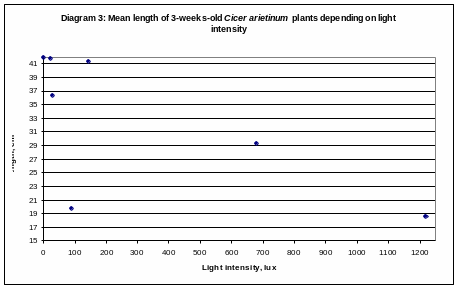
| Light intensity, lux | Mean wet biomass, g | Mean dry biomass, g | % of water | Mean length, cm | Mass of chl. In 1 g |
| 0 | 0,273 | 0,041 | 84,98 | 41,89 | 0,0000 |
| 20,5 | 0,579 | 0,056 | 90,33 | 41,76 | 0,0496 |
| 27,5 | 0,332 | 0,033 | 90,06 | 36,33 | 0,1462 |
| 89,5 | 0,181 | 0,018 | 90,06 | 19,81 | 0,1769 |
| 142 | 0,511 | 0,047 | 90,80 | 41,33 | 0,0697 |
| 680 | 0,338 | 0,043 | 87,28 | 29,33 | 0,1557 |
| 1220 | 0,301 | 0,034 | 88,70 | 18,64 | 0,1939 |
Calculation of amount of chlorophyll in plants basing on the results of titration
H2 SO4 + C56 O5 N4 Mg => C56 O5 N4 H + MgSO4
Concentration of H2SO4 is 0,01 M
C – concentration
V – volume
n – quantity of substancy
m – mass
Mr – molar mass
For light intensity equal to 20,5 lux.
n = V (in dm3) ∙ C
2 ∙ 10-3 ∙ 0,01 = 2 ∙ 10-5
n = m / Mr => m = n ∙ Mr
m = 2 ∙ 10-5 ∙ 832 = 1,664 ∙ 10-2 grams
mass of plant mass of chlorophyll
1,68 grams - 0,08335 grams of chlorophyll
1 gram - x grams of chlorophyll
Hence there are 0,0496 grams of chlorophyll.
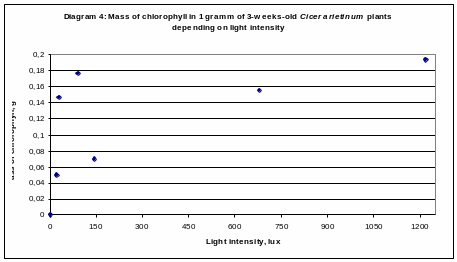
Table 5. The correlation between mean length of plants and mean dry biomass.
| Site | Mean length, cm | Rank (R1) | Mean dry biomass, g | Rank (R2) | D (R1-R2) | D2 | |
| 1 | 41,89 | 1 | 0,041 | 4 | -3 | 9 | |
| 2 | 41,76 | 2 | 0,056 | 1 | 1 | 1 | |
| 3 | 36,33 | 4 | 0,033 | 6 | -2 | 4 | |
| 4 | 19,81 | 6 | 0,018 | 7 | -1 | 1 | |
| 5 | 41,33 | 3 | 0,047 | 2 | 1 | 1 | |
| 6 | 29,33 | 5 | 0,043 | 3 | 2 | 4 | |
| 7 | 18,64 | 7 | 0,034 | 5 | 2 | 4 | |
| Rs = 0,57 | |||||||
| critical value = 0,79 | |||||||
| | |||||||
0,57<0,79, therefore there is no significant correlation between mean length of plants and mean dry biomass.
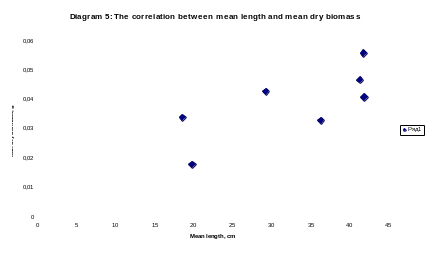
Table 6. The correlation between mean length and mass of chlorophyll per 1 g of plant.
| Site | Mean length, cm | Rank (R1) | Mass of chl. In 1 g | Rank (R2) | D (R1-R2) | D^2 | |
| 1 | 41,89 | 1 | 0,0000 | 7 | -6 | 36 | |
| 2 | 41,76 | 2 | 0,0496 | 6 | -4 | 16 | |
| 3 | 36,33 | 4 | 0,1462 | 4 | 0 | 0 | |
| 4 | 19,81 | 6 | 0,1769 | 2 | 4 | 16 | |
| 5 | 41,33 | 3 | 0,0697 | 5 | -2 | 4 | |
| 6 | 29,33 | 5 | 0,1557 | 3 | 2 | 4 | |
| 7 | 18,64 | 7 | 0,1939 | 1 | 6 | 36 | |
| |||||||
There is negative correlation between mean length of plants and mass of chlorophyll per 1 g of plant
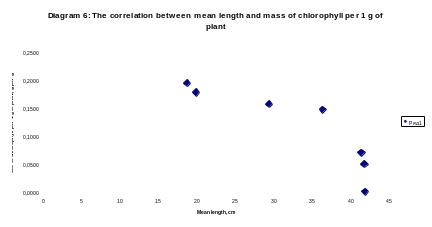
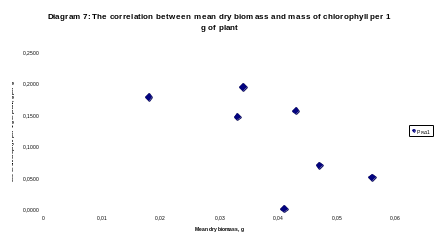
Table 7. The correlation between mean dry biomass and mass of chlorophyll per 1 g of plant.
| Site | Mean dry biomass, g | Rank (R1) | Mass of chl. In 1 g | Rank (R2) | D (R1-R2) | D^2 | |
| 1 | 0,041 | 4 | 0,0000 | 7 | -3 | 9 | |
| 2 | 0,056 | 1 | 0,0496 | 6 | -5 | 25 | |
| 3 | 0,033 | 6 | 0,1462 | 4 | 2 | 4 | |
| 4 | 0,018 | 7 | 0,1769 | 2 | 5 | 25 | |
| 5 | 0,047 | 2 | 0,0697 | 5 | -3 | 9 | |
| 6 | 0,043 | 3 | 0,1557 | 3 | 0 | 0 | |
| 7 | 0,034 | 5 | 0,1939 | 1 | 4 | 16 | |
| Rs = -0,57 | |||||||
| | |||||||
0,57<0,79, therefore there is no significant correlation between mean dry biomass and mass of chlorophyll per 1 g of plant
V. Discussion.
Several tendencies can be clearly seen.
For the first, with the increase of light intensity mean length of plants is decreasing, but there are exceptions. For light intensity 142 lux the value of mean length is approximately equal to the values of length for light intensities 0 lux and 20,5 lux. If exclude this data it is also seen that for light intensity equal to 680 lux mean length is also slightly falling out from the main tendency – decreasing from 19.81 cm.
The second tendency is increase of mass of chlorophyll per 1 gram of plant biomass with the increase of light intensity. But the values of mass of chlorophyll of those plants under light intensities 142 lux and 680 lux are falling out from the main tendency. The first and the second ones are too small – approximately equal to the value corresponding to 20.5 lux light intensity and to 89.5 lux respectively. This may happen because not all the seeds of Cicer arietnum were of the same quality, because it is impossible to guarantee that more than 250 seeds in one box have the same high quality. At the mean time it was expected that starting from the light intensity more than 680 lux the amount of chlorophyll in plants will decrease, because the value of destructed chlorophyll with be bigger than the value of newly formatted. But the experiments showed that the amount of chlorophyll was constantly increasing even when the light intensity level exceeded the point 1220 lux. This could happen because light intensity equal to 1220 lux is not so extremely high that the amount of total chlorophyll in plants will start decreasing.
Also it is clearly seen that there are no correlations between light intensity and values of wet and dry biomass.
Basing on these arguments the sudden decrease of the amount of chlorophyll in plants placed on light intensity equal to 142 lux was likely to be insignificant and could not be considered as a trend.
But it is impossible to forget such important factor as plant hormones that affect the growth and development of plants. There are five generally accepted types of hormones that influence plant growth and development. They are: auxin, cytokinin, gibberellins, abscic acid, and ethylene. It is not one hormone that directly influences by sheer quantity. The balance and ratios of hormones present is what helps to influence plant reactions. The hormonal balance possibly regulates enzymatic reactions in the plant by amplifying them.
VI. Conclusion.
Due to results of my investigation it is seen that my hypothesis didn’t confirm fully (for example, comparing the diagram 1 and diagram 7), because I proposed that when light intensities will be very high, mass of chlorophyll in plant will start decreasing and due to my observations it didn’t happen. I should say that the only reason I can suggest is that I haven’t investigated such extremely high light intensities, so that chlorophyll start destructing. But if we will not pay attention to that fact the other part of my hypothesis was confirmed and mass of chlorophyll in plants increased with the increase of light intensity. Furthermore I didn’t estimate amount of plant hormones and so didn’t estimate their influence on results.
Questions for further investigation:
-
Investigating very high light intensities.
-
Implementation of colorimetric analysis.
-
Paying attention to estimation of plant hormones level.
Those questions should be further investigated in order to get clearer picture and more accurate results of the dependence of the amount of chlorophyll in plants on the light intensity, knowing the fact that the amount of chlorophyll has a tendency to decrease at extremely high light intensities. So this statement needs an experimental confirmation and as in this investigation conditions with extremely light intensity were not created in further investigations they have to be created.
Implementation of colorimetric analysis is also very important thing, because it gives much more accurate results comparing with the titration method. The colorimetric method suggests that as different pigments absorb different parts of light spectrum differently, the absorbance of a pigments mixture is a sum of individual absorption spectra. Therefore the quantity of each individual pigment in a mixture can be calculated using absorbance of the certain colors and molecular coefficients of each pigment. This was proposed by D. A. Sims, and J. A. Gamon (California State University, USA)5 with the reference on Lichtenthaler (1987).
VII. Evaluation.
There are several results in my work, that are falling out from the main tendencies. It may seem that such results may occur due to different percentage of water in plants, but when I was calculating mass of chlorophyll in 1 gram of plant I was using only values of mean dry biomass so it couldn’t affect my results. (see table 3)
At the same time such differences in the percentage of water are easily explained. The rate of evaporation of water from plants, which were put under 1220 lux light intensity was much higher than of those put under 20.5 lux light intensity, therefore percentage of water in the soil may vary, though I provided all the plants with the same volume of water at the same periods of time.
One more reason that could be proposed is the reason connected with the pH of water with which flowers were provided. It was not measured but the thing that could have happened is that it had somehow changed the pH of soil in which seeds were placed and therefore changed the amount of synthesized chlorophyll.
Titration is not a perfect way of obtaining results. This happens because the method is based on visual abilities of a person – he has to decide whether the color he obtained is dark olive-green or not so dark olive-green. Such a situation concerns lots of mistakes due to different optical abilities of each person, even some humans are not able to distinguish those colors, because of the disease called Daltonism.
Even those who do not suffer from this disease can also make mistakes in such experiment. It is known that people who suffer from Myopia can hardly see objects that are far from them, but don’t have problems with objects that are near, but it is also important to take into consideration the fact that their ability to distinguish colors is also lower comparing with humans with normal eyesight.
There also exist the so called human factor, which also affects the investigation. Man can’t be absolutely objective, because sometimes it is too hard for a person to falsify his own theory or hypothesis, so one can ignore results that are not suitable for his statements and select only those that are suitable, which will also affect the investigation not in good way.
So as human’s eye is not a perfect instrument and humans are not perfectly objective there should be other methods of investigating the amount of chlorophyll in plant.
Moreover titration method doesn’t distinguish between chlorophylls-a and chlorophyll-b, phaeophytin-a and phaeophytin-b, as their colors differ, this giving not very accurate results. Also due to this limiting factor it is impossible to know whether the whole amount of chlorophyll reacted with the sulfuric acid and again it adds an uncertainty to the results. Furthermore the saturation of color depends on the extent of dilution and it is nearly impossible to say if the solution was diluted till the same color or not, because it is very difficult to distinguish between different shades of olive green color.
BIBLIOGRAPHY
-
Allott, Biology for IB diploma (standard and higher level), Oxford University Press, ISBN 0-19914818
-
M. Roberts, M. Reisse, G. Monger, Biology: principles and approaches, Nelson, ISBN 0-17-44-8176-4
-
T. King, M. Reiss, M. Roberts, Practical advanced biology, Nelson Thorns, ISBN 0-170448308-
-
Викторов Д. П., Практикум по физиологии растений. – 2-е изд. – Воронеж: ВГУ, 1991
-
http://www.ac-creteil.fr/svt/Tp/Tp2/Tp2UK2/fiches_them_choix-P2/genechloro.doc, 15/03/2004
-
http://vcsars.calstatela.edu/esa_posters/ds/dan_esa99.html 05/05/2004
-
http://www.agsci.ubc.ca/courses/fnh/410/colour/3_21.htm, 16/03/2004
-
http://vcsars.calstatela.edu/esa_posters/ds/dan_esa99.html, 22/02/2004
-
http://www.charlies-web.com/specialtopics/anthocyanin.html. 17/04/2004
-
http://www.ch.ic.ac.uk/local/projects/steer/chloro.htm, 11/04/2004
-
http://www.bonsai.ru/dendro/physiology5.html 02/04/2004
-
http://www.iger.bbsrc.ac.uk/Publications/Innovations/in97/Ch2.pdf, 06/05/2004
1 http://www.bonsai.ru/dendro/physiology5.html 02/04/2004
2 www.iger.bbsrc.ac.uk/igdev/iger_innovations/ 06/05/2004
3 http://www.ch.ic.ac.uk/local/projects/steer/chloro.htm 11/04/2004
4 Викторов Д. П., Практикум по физиологии растений. – 2-е изд. – Воронеж: ВГУ, 1991, p.66
5 http://vcsars.calstatela.edu/esa_posters/ds/dan_esa99.html 05/05/2004
20