168518 (625135), страница 3
Текст из файла (страница 3)
In North America the early environmentalists encouraged emulation of indigenous peoples and enriching the natural ecology with slow patient effort. For example, Chapman, also known as “Johnny Appleseed” alone planted millions of apple trees throughout the United States. The movement had little or no explicit political character. It was mostly aesthetic. It had no central doctrine. Most of its proponents did not know each other, but created a powerful discourse that influenced people strongly at the time.
The Conservation movement was an American invention of John Audubon and others who invoked Christian reverence for the Creation to protect natural habitat from man in the 19th century. They lobbied consistently for parks and human exclusion from "the wild". They saw humans as apart from nature, in line with Judeo-Christian ethics of the time, and believed that an awe of biodiversity (as we call it today), would inspire religious piety.
By contrast with the Conservation movement, early enviromentalists did not lobby for parks or human exclusion from "the wild". They did not see humans as apart from nature.
The harshest critic of the environmental movement in the 20th century was probably Ayn Rand, who considered it to be the opponent of human morality, creativity and industry.
Largely due to the political critique and confusion, and a growing concern with the environmental health problems caused by pesticides, some serious biologists and ecologists created the scientific ecology movement which would not confuse empirical data with visions of a desirable future world.
Today it is the science of ecology, rather than any aesthetic goals, that provide the basis of unity to most environmentalists. All would accept some level of scientific input into decisions about biodiversity or forest use. Most would generally deny that there is such a thing as “enviromentalism” and consider that phrase an invention of enemies.
The environmental movement today persists in many smaller local groups, usually within ecoregions. Some resemble the U.S. conservation movement - whose modern expression is the Sierra Club, National Geographic Society and other American organizations with a worldwide influence.
These "politically neutral" groups tend to avoid global conflicts and view the settlement of inter-human conflict as separate from regard for nature - in direct contradiction to the ecology movement and peace movement which have increasingly close links: While Greenpeace, and other Green Parties for example, regard ecology, biodiversity and an end to non-human extinction as absolutely basic to peace, the local groups may not, and may see a high degree of global competition and conflict as justifiable if it lets them preserve their own local uniqueness.
There are different types of environmental organizations. Four of them, I want to mention in my paper. They are:
-
Government Organizations
-
Intergovernmental Organizations
-
Private Organizations (Environmental NGO10)
-
International Organizations
The government organizations are the government departments or agencies devoted to monitoring and protecting the environment. In Canada, the most known federal environmental agency is the Environment Canada. It is responsible for weather forecasting, managing and administration of National and conservation parks, water and forest protection and so on. The English Heritage is a United Kingdom government body with a broad remit of managing the historic environment of England. Its major responsibilities are the conservation, advising, registering and protecting the historic environment. The mission of the United States Environmental Protection Agency (EPA) is to protect human health and to safeguard the natural environment: water, air, land.
Intergovernmental organizations, such as the European Environment Agency, are devoted to establishing a monitoring network for monitoring the European environment.
The Environmental NGO include only social and cultural groups, whose primary goal is not commercial. These organizations are involved in lobbying, advocacy, or conservation efforts.
The international organizations, like Greenpeace, Green Cross International and Friends of Earth, use direct actions to stop the destruction of the natural environment. At this part I would like to describe the Greenpeace organization and its action.
Greenpeace is an independent, campaigning organization which uses non-violent, creative confrontation to expose global environmental problems, and to force solutions for a green and peaceful future. Greenpeace's goal is to ensure the ability of the earth to nurture life in all its diversity. Greenpeace has national and regional offices in 41 countries worldwide.
The origins of Greenpeace lie in the formation of the Don't Make A Wave Committee. Taking its name from a slogan used during protests against United States nuclear testing in late 1969, the Committee came together with the objective of stopping a second underground nuclear bomb test codnamed "Cannikin" by the United States military beneath the island of Amchitka, Alaska. In September 1971, a fishing vessel skippered by John Cormack. was named the Greenpeace, and set sail for the island of Amchitka with the intention of disrupting the scheduled second nuclear test. Upon their return to Alaska, the crew learned that protests had taken place in all major Canadian cities, and that the United States had postponed the second underground test until November. Although attempts to sail into the test zone using a second chartered vessel also failed, no further nuclear tests took place at Amchitka. Following Stowe's departure from the chairmanship of the Don't Make A Wave Committee, the fledgling environmental group officially changed its name to the "Greenpeace Foundation".
By the late 1970s, spurred by the global reach of what Robert Hunter called "mind bombs”, more than 20 groups across North America, Europe, New Zealand and Australia had adopted the name "Greenpeace".
In 1979, however, the original Vancouver-based Greenpeace Foundation had encountered financial difficulties, and disputes between offices over fundraising and organisational direction split the global movement. David McTaggart lobbied the Canadian Greenpeace Foundation to accept a new structure which would bring the scattered Greenpeace offices under the auspices of a single global organisation, and on October 14, 1979, Greenpeace International came into existence. Greenpeace's transformation from a loose international network — united by style more than by focus — to a global organisation able to apply the full force of its resources to a small number of environmental issues deemed of global significance.
In 1978, Greenpeace launched the Rainbow Warrior, a 40-metre, former fishing trawler named for the Creek legend that inspired early activist Robert Hunter on the first voyage to Amchitka. Greenpeace purchased the Rainbow Warrior (originally launched as the Sir William Hardy in 1955) at a cost of £40,000, and volunteers restored and refitted her over a period of four months.
The Rainbow Warrior would quickly become a mainstay of Greenpeace campaigns. Between 1978 to 1985, crew members also engaged in non-violent direct action against the ocean-dumping of toxic and radioactive waste, the Grey Seal hunt in the Orkneys and nuclear testing in the Pacific.
Greenpeace's continued protest against nuclear testing at Moruroa atoll prompted the government of France to order the bombing of the Rainbow Warrior, in Auckland, New Zealand, in 1985.
The Warrior had sailed from the North Pacific, where it assisted the evacuation of the inhabitants of Rongelap in the Marshall Islands, who continued to suffer health effects attributed to the fallout from American nuclear testing during the 1950s and 1960s.
The organization currently actively addresses many environmental issues, with primary focus on efforts to stop global warming and to preserve the biodiversity of the world's oceans and ancient forests. In addition to the more conventional environmental organization methods, such as lobbying politicians and attendance at international conferences, Greenpeace has a stated methodology of engaging in nonviolent direct action.
Greenpeace uses direct action to attract attention to particular environmental causes, whether by placing themselves between the whaler's harpoon and their prey, or by invading nuclear facilities dressed as barrels of radioactive waste.
Some of Greenpeace's most notable successes include the ending of atmospheric testing of nuclear weapons, a permanent moratorium on international commercial whaling, and the declaration by treaty of Antarctica as a global park, forbidding possession by individual nations or commercial interests. To back up this latter point, World Park Base was established in Antarctica.
Despite its founding in North America, Greenpeace achieved much more success in Europe, where it has more members and gets most of its money. The vast majority of Greenpeace's donations come from private individual members.
During its history, Greenpeace has weathered criticism from government and industry, and on occasion, from other environmental groups. While critics have often focused on undermining the scientific or factual basis of particular campaigns, the organisation's system of governance and its use of nonviolent direct action have also been sources of controversy.
Conclusion
So, pollution is one of the most burning problems of nowadays. Now millions of chimneys, cars, buses, trucks all over the world exhaust fumes and harmful substances into the atmosphere. These poisoned substances pollute everything: air, land, water, birds and animals. So, it is usually hard to breathe in the large cities where there are lots of plants. Everything there is covered with soot and dirt. All these affect harmfully. Every year the atmosphere is polluted by about 1000 tons of industrial dust and other harmful substances. Big cities suffer from smog. Cars with their engine have become the main source of pollution in industrial countries. Vast forests are being cut down for the need of industries in Europe and USA. The loss of the forests upsets the oxygen balance of the new wastelands. As the result some species of animals, birds, fish and plants have disappeared and keep disappearing. To slow down the rate of pollution many environmental organizations engage in nonviolent actions. But it is surely not enough to stop the processes that have already began in nature, and that had been caused by the way we all live. To protect our environment we all should care and do everything possible to save the nature for our kids.
Appendix
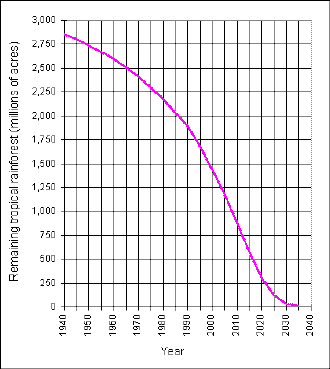
#1. Rates of deforestation
#2. Carbon Dioxide Emissions per Units of Economic Output
| Country | Emissions (metric tons CO2/year | GNP (billions of $/year) | Emissions/GNP Ratio (metric tons CO2/year) |
| China | 2,236.3 | 372.3a | 6.01b |
| South Africa | 284.2 | 79.0 | 3.60 |
| Romania | 220.7 | 79.8a | 2.77b |
| Poland | 459.4 | 172.4 | 2.66 |
| India | 600.6 | 237.9 | 2.52 |
| East Germany | 327.4 | 159.5a | 2.05a |
| Czechoslovakia | 233.6 | 123.2a | 1.90b |
| Mexico | 306.9 | 176.7 | 1.74 |
| U.S.S.R. | 3,982.0 | 2,659.5a | 1.50b |
| South Korea | 204.6 | 171.3 | 1.19 |
| Canada | 437.8 | 435.9 | 1.00 |
| United States | 4,804.1 | 4,880.1 | .98 |
| Australia | 241.3 | 246.0 | .98 |
| United Kingdom | 559.2 | 702.4 | .80 |
| Brazil | 202.4 | 323.6 | .63 |
| West Germany | 669.9 | 1,201.8 | .56 |
| Spain | 187.7 | 340.3 | .55 |
| Italy | 359.7 | 828.9 | .43 |
| Japan | 989.3 | 2,843.7 | .35 |
| France | 320.1 | 949.4 | .34 |
| a Estimates of GNP for centrally planned economies are subject to large margins of error. These estimates are as much 100 times larger than those from other sources that correct for availability of goods or use free-market exchange rates. | |||
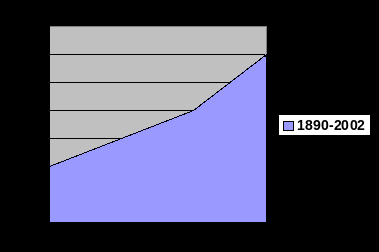
# 3 Increase of global surface temperature
References
-
Крискунов Е.А. Экология (учебник), М.1995г.
-
Валерий Павлович Алексеев “ПРИРОДА И ОБЩЕСТВО: ЭТАПЫ ВЗАИМОДЕЙСТВИЯ” Экология и жизнь,№ 2, 2002г.
-
А.Д. Яншин “Научные проблемы охраны природы и экологии” Экология и жизнь, № 3, 1999 г.
-
«В мире науки». Журнал, 1990г., #10.
-
«Калейдоскоп». Журнал, 1997., #12.
-
Энциклопедия «Аванта+», т. 19 Экология, М: «Аванта+», 2001г.
Multimedia Editions
-
Britannica Encyclopedia (Multimedia Edition)
Internet data:
-
www.greenpeace.com
-
www.world-ecology.com
-
Advances in Environmental Research www.elsevier.com
-
National Academy of Sciences, Policy Implications of Global Warming (Washington, D.C.: 1991)
-
Jeannie Allen. “Tango in the Atmosphere: Ozone & Climate Change”//NASA Earth Observatory. 10.02.2004. http://earthobservatory.nasa.gov/Study/Tango/
-
“Scientists find Ozone-Destroying Molecule”//NASA Goddard Space Flight Center. 09.02.2004. http://www.gsfc.nasa.gov/topstory/2004/0205dimers.html
-
“Круговорот кислорода. Озоновый экран.”Учебный материал Российской коллекции рефератов. http://www.referats.net/cgi-bin/referats/rkr/jump.cgi?ID=20073
1 Styrofoam - пенопласт
2 Advances in Environmental Research www.elsevier.com
3 Advances in Environmental Research www.elsevier.com
4 А.Д. Яншин “Научные проблемы охраны природы и экологии” Экология и жизнь, № 3, 1999 г.
5 Валерий Павлович Алексеев “ПРИРОДА И ОБЩЕСТВО: ЭТАПЫ ВЗАИМОДЕЙСТВИЯ” Экология и жизнь,№ 2, 2002г.
6 National Academy of Sciences, Policy Implications of Global Warming (Washington, D.C.: 1991)
7 Валерий Павлович Алексеев “ПРИРОДА И ОБЩЕСТВО: ЭТАПЫ ВЗАИМОДЕЙСТВИЯ” Экология и жизнь,№ 2, 2002г.
8 Lake Manapouri is a lake in the South Island of New Zealand
9 Genetic engineering
10 A non-government organization