ВКР Ильина АО (1226309), страница 12
Текст из файла (страница 12)
FDI inflows to developed countries declined by 14% in 2014, mainly due to lower investments in the US economy. FDI in the EU grew by 13% in 2014, but still account for only one third of the peak in 2007
FDI in the transition economies decreased by half, reaching 45 billion US dollars. The reasons are regional conflicts, sanctions aimed at RF, thus the negative growth prospects deter foreign investors (especially from developed countries) from investing in the region.

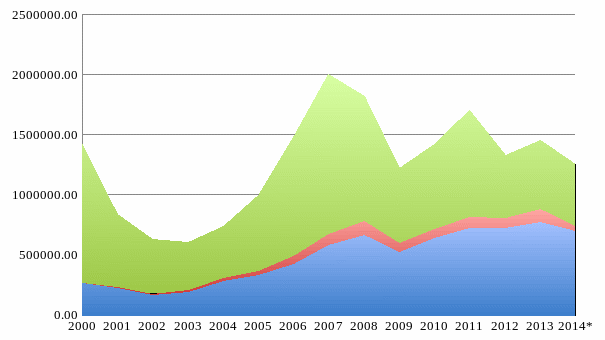
Figure 1.1 Global FDI flows by country group, 2000-2013. (in bln. dollars)
FDI flows to developing countries reached a new high of more than 700 bln. dollars, 4% higher than in 2013, with a global share of 56%. At the regional level, the flow of Asian developing countries increased investment to Africa remained the same, while the interest of investors in the economy of Latin America declined.
In 2014, China, with a modest increase of 3%, was the largest recipient of FDI in the world. The United States has become the 3rd largest host country, lost the lead in terms of attracting investments for the first time since 2003 and received almost a third of the level of FDI in 2013 among the top five recipients of FDI in the world, four developing countries: China, Hong Kong, Singapore, and Brazil.
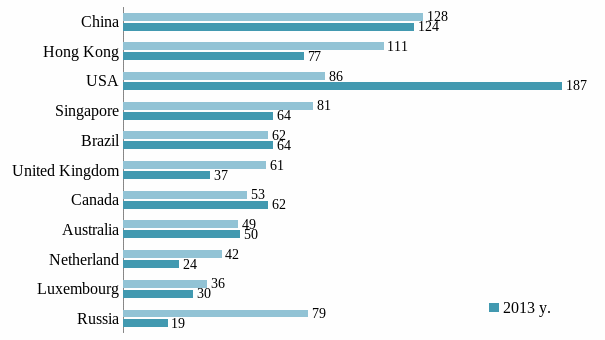
Figure 1.2 The leading countries in terms of FDI in 2014, bln. dollars
In recent years, Russia is consistently among the top-ranked countries in attracting FDI. In 2013, Russia ranked third in attracting FDI in the economy, such a high result was achieved thanks to the acquisition of the British company BP 18,5% stake in "Rosneft". In 2014, the flow of FDI into the Russian economy fell by more than half compared with the previous years. Negative growth prospects due to the sanctions and regional conflicts deter investors from long-term investments [6].
UNCTAD estimates the future growth prospects of FDI as "unclear". Among the factors that could adversely affect the market, referred to consumer uncertainty, volatility in currency markets and geopolitical instability. In addition, the decline in commodity prices is likely to lead to a lack of investor interest in the investment in these assets. On the other hand, the strengthening of economic growth in the United States, boosting demand for the impact of low oil prices and active monetary policy in the eurozone, combined with further liberalization, a positive effect on the inflow of FDI.
1.2 Factors of investment attractiveness of the region for foreign investors
Today the role of the regions in addressing the socio-economic development is greatly increased. In order to separate the region acted not as a recipient and a donor of the federal budget, it has to take an active investment position and, together with the business community to work to improve the investment attractiveness, especially for foreign investors.
Implementation of foreign investments in the region will initially be advisable with a favorable combination of parameters of profitability and risk. The investment factors then are the risk factors and yield factors. Accordingly, the investment potential of the region will be determined by the yield factor, i.e. security of its raw materials, infrastructure, labor and so on. Risk factors characterize the regional investment climate, which is determined by the degree of development of investment laws, customs and tax administration, difficulties in registering property, and so on. Comparing risk factors and profitabilities, the investor defines appeal of this or that region and makes the decision on investment. Often this classification is added to the third factor - the time factor. Term of realization of the investment project is also important for strategic investors. Being guided by three indicators: the risk, profitability, realization terms, investors first of all solve, whether it is worth investing money in the project or not. Thus, by comparison of characteristics of the project usefulness of investment climate of the region is defined. Figures 1.3 and 1.4 reflect the favorable and unfavorable investment climate in the region.

Figure 1.3 An unfavorable investment climate
Accordingly, the investment climate in the region is unfavorable, if the income from the sale of the future project low compared to the long turnaround time and high risk.
Unfortunately, in Russia the majority of regions can't offer an ideal combination of risk, profitability and term of implementation of the project. Investment climate of regions assessed as unfavorable.

Figure 1.4 A favorable investment climate
This chart reflects the worst-case scenario. Figure 1.4 shows the region attractive to investors, where the project will be implemented as efficiently at low risk that the project will bring big profits in a short time.
Most regional differences generated by their prevailing historical features. For example, the investment climate of the Khabarovsk Territory, the Nenets Autonomous District, the Republic of Sakha (Yakutia), the Kemerovo region and other regions of unfavorable raw due to their economically justified specialization in raw materials. In such regions neglected their overall socio-economic development. Of course, this region is necessary to form a favorable investment climate.
Consider the factors that shape a favorable or unfavorable investment climate for foreign investors.
Various classifications of factors of FDI are published in different sources and, having generalized theoretical material, it is possible to allocate five main groups of factors of attraction of FDI in national economy, including:
1. Economic factors: the size of the market, the price of the factors of production, the quality of the factors of production, the gross national product;
2. Development of infrastructure: transport, communications, financial and other institutions;
3. The implementation of economic policies (the national and regional, including foreign trade);
4. Ease of doing business in the country: the factors, ratings, surveys;
5. The geographical features of the market.
Consider the international classification of investment factors. Most interesting is the classification of the factors that make up the composite index of the attractiveness of UNCTAD.
Since 2002, UNCTAD has been publishing an annual World Investment Report, which reflects the attractiveness of the indices around the world as host of investment.
UNCTAD identifies four basic factors of the investment attractiveness of the region or country:
1. Market Attractiveness:
- Market size (GRP purchasing power parity);
- The purchasing power (GDP per capita, purchasing power parity).
- Potential market growth (growth of real GRP).
2. The price and quality of the workforce, in particular their availability:
- Labour costs per unit of production (hourly wages, labor productivity);
- Production potential of the labor force (the quality of the workforce).
3. The presence of natural resources:
- Exploitation of natural resources (non-fuel exports of ores);
- Agricultural resources (availability of arable land).
4. Availability of the necessary infrastructure:
- Transport (density of the road network, the overall proportion of paved roads, the total length of railway lines, liner shipping connectivity index)
- Energy Consumption (electric power);
- Communication (local telephone subscribers, Cellular mobile subscribers, high-speed Internet).
Depending on importance of direct factors for investors three types of investors are allocated (according to the three first factors):
1) Investors, market-oriented.
2) Investors focused on efficiency.
3) Investors focused on resources.
Every investor is looking for the best deal possible for a combination of four factors and selects the most favorable for their business area. Even if that UNCTAD focuses on global indicators as a whole, these factors can be adapted to Russian regions that are very different to each other, not only on the size of the market, but also on other indicators such as labor, natural resources, infrastructure provision and much more. In a rating of National Rating Agency seven factors of regional investment appeal are considered:
1) Ensuring the region's natural resources and environmental quality in the region: the presence in the region, the main types of natural resources (including fuel and energy), environmental pollution, the possibility of sewage treatment and waste production, energy intensity of the regional economy.
2) Human resources in the region: the main characteristics of the labor force in the region, including the economically active population, employment and unemployment, the volume of supply of skilled labor, as well as productivity.
3) Regional infrastructure: the level of development and the availability of both "hard" and "soft" infrastructure. The concept of "hard" infrastructure includes transport, energy, telecommunications, and housing infrastructure. 'Soft' infrastructure includes several components, of which from the point of view of investment appeal is most important financial infrastructure.
4) The internal market in the region (the potential of regional demand): the level of development of the internal market in the region (including the scale of the sectors of retail trade and paid services), disposable income and purchasing power of the population in the region.
5) The production potential of the regional economy: the aggregate results and characteristics of the economic activity of enterprises already operating in the region (the volume and dynamics of production, asset size, quality and efficiency of their use), the branch structure of the regional economy, the level of development of innovative industries.
6) Institutional environment and socio-political stability: expert assessment of the effectiveness of regional legislation regulating the interaction between government and investors expert assessment of favorable regional tax law (the existence of tax benefits and the possibility of their receipt), the level of crime and social tension in the region.
7) The financial sustainability of the regional budget and enterprises in the region: the state of public finances in the region (the amount of tax revenues, budget balance, the regional government debt) and the assessment of the financial situation of enterprises in the region (profitability (loss-making) companies, the state of accounts payable and receivable organizations, the presence of investment resources) [20].