ВКР Константинова К. К. (1190304), страница 9
Текст из файла (страница 9)
The pharmaceutical industry is one of the most rapidly developing industries. World pharmaceutical market is a powerful conglomeration of manufacturers and sellers of products for health, academic researchers, creating a new treatment, consumers — patients who buy products and doctors, who dispense these products.
The pharmaceutical market has a number of features:
1. A high proportion of generic (medicine with the composition and form as the original drugs, but without patent protection) and the predominance of over-the-counter drugs;
2. The transition of most companies to production finished medicinal products;
3. The health insurance, which covers part of the costs of medicines, treatment, etc.;
4. The tendency of the population to herbal medicine, self-medication, buying cheap medications.
The main participants of the pharmaceutical market are pharmaceutical manufacturers, distributors, pharmacies, doctors, consumers and the government (figure 1).

Figure 1 The participants of the pharmaceutical market
As can be seen from the figure, the chain Manufacturer - Buyer has its own characteristics – pharmaceutical agents - by which drugs get to the consumers. Distributors contribute to the spread of pharmaceutical products of manufacturer and interact with pharmacies. Medical representatives from the manufacturer work with pharmacies, encouraging them to order drugs or to increase the shipment of drugs from certain pharmaceutical companies. Pharmacies order a form and send it to the distributor who delivers them pharmaceutical products. Medical representatives also work with doctors, telling them about the benefits of their drugs. Doctors have discretion to prescribe these drugs to their patients (consumers). The consumer receives a doctor's prescription and goes to the pharmacy, where he/she buys drugs. Thus, the pharmaceutical products from the manufacturer gets to the buyer. Moreover, the government has the important role, regulating this process at every stage.
Nowadays many factors affect the growth of the pharmaceutical market. These include the increase in the total diseases due to environmental problems; the ongoing process of population ageing that is characteristic of developed countries; the permanent increase in household incomes, which encourages the use of more expensive and quality drugs (figure 2).
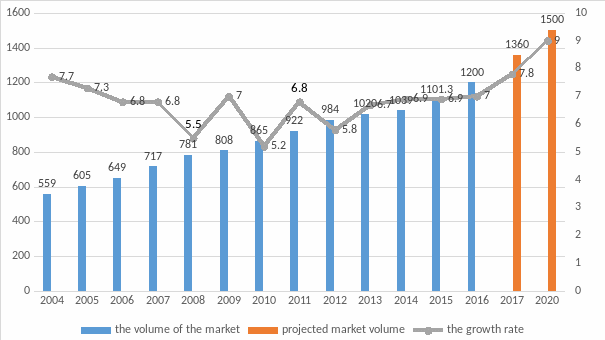
Figure 2 – The volume and the growth rate of the world pharmaceutical market
In value terms, the largest part of the modern medicine market accounts for Western Europe and North America (table 1).
Table 1 World pharmaceutical market in 2013-2015
| Region | Market volume (billion dollars), 2013 | Market volume (billion dollars), 2014 | Market volume (billion dollars), 2015 | The difference (2014/2015), % | The difference (2013/2015), % |
| The world | 1020 | 1039 | 1101,3 | 6,0 | 7,9 |
| North America | 399,0 | 406,2 | 430,2 | 5,9 | 7,8 |
| Europe | 235,6 | 243,0 | 251,3 | 3,5 | 6,6 |
| Asia (without Japan) and Africa | 179,9 | 201,5 | 218,6 | 8,5 | 21,5 |
| Japan | 86 | 88,0 | 89,7 | 1,9 | 4,3 |
| Latin America | 68,3 | 75,5 | 83,1 | 10,1 | 21,7 |
According to the data presented in the table, we can conclude that high rates of short-term growth are the characteristic of pharmaceutical markets of Asia and Latin America. In near future, China will provide up to two thirds of growth in the world market, at its competitor it can be only the USA, but their role in the global pharmaceutical arena will not be as significant. According to experts, the share of China and the United States in the next few years will be up to 80% of the growth in the volume of the world pharmaceutical market.
10 largest global pharmaceutical companies participate the influential group of "Big pharma". Its R & d exceeds constitute about 70 billion dollars, and sales constitute 500 billion dollars.
The top of the Big Pharma sales in the world market in 2016 amounted to such companies as "Pfizer", "Novartis", "Roche", "Sanofi" and "Merck & Co", traditionally positioned among the leaders for many years (table 2, figure 3).
Table 2 Sales of Big Pharma group in 2012, 2014, 2016
| № | The company | Country | Sales in 2012, billion dollars | Sales in 2014, billion dollars | Sales in 2016, billion dollars | The difference (2012/ 2014), % | The difference (2012/ 2016), % |
| 1 | Pfizer | USA | 46,7 | 42,5 | 48 | -8,9 | 2,7 |
| 2 | Novartis | Switzerland | 50,5 | 43,1 | 44,5 | -14,6 | -11,8 |
| 3 | Roche | Switzerland | 35,3 | 38,3 | 39,8 | 8,4 | 12,7 |
| 4 | Sanofi | France | 37,4 | 34,8 | 39,7 | -6,9 | 6,1 |
| 5 | Merck&Co | USA | 39,8 | 35,2 | 37,9 | -11,5 | -4,7 |
| 6 | GlaxoSmithKline | UK | 33,1 | 28 | 33,5 | -15,4 | 1,2 |
| 7 | Johnson&Johnson | USA | 27,1 | 29,9 | 33,2 | 10,3 | 22,5 |
| 8 | GileadSciences | USA | 26,9 | 32,2 | 30,1 | 19,7 | 11,8 |
| 9 | AbbVie | USA | 28,6 | 22,7 | 26 | -20,6 | -9,1 |
| 10 | AstraZeneca | UK | 30,4 | 27,6 | 22,7 | -9,2 | -25,3 |
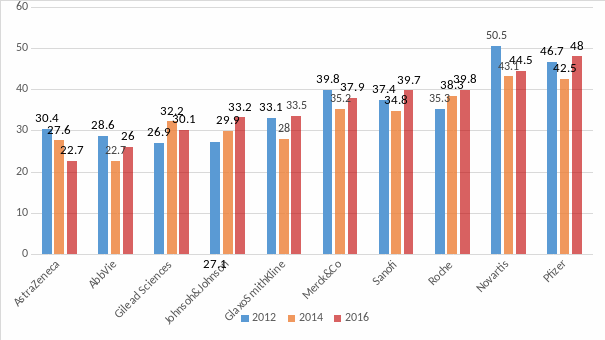
Figure 3 Sales of Big Pharma group in 2012, 2014, 2016
According to the table and the bar chart, it can be concluded that the pharmaceutical market is a rapidly changing market.
Company "Pfizer" managed to lead the ranking. The company "Novartis", who was the leader position of this rating by the end of 2014, took 2nd place in the rating. Closes the top three, slightly ahead of the "Sanofi" "Roche" company.
Trends in the global pharmaceutical market affected the functioning of the markets of different countries, including Russian market.
The volume of Russian pharmaceutical market in 2016 reached 1 372 billion, which is 8.9% higher than a year earlier. In general, the volume of the commercial market in value terms has continued steady growth, and forecasts for 2017 predict the 9.6% growth compared with the year 2016 and will be about 1503 billion (figure 4).
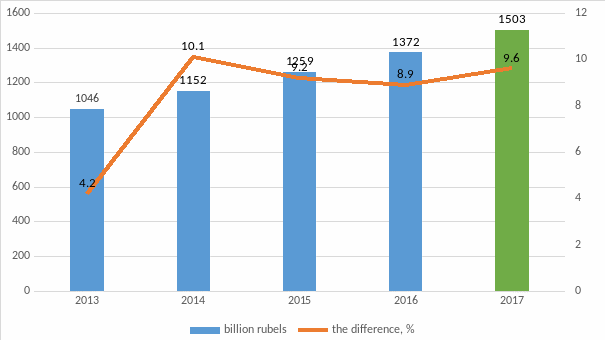
Figure 4 The volume of commercial market of medicines, billion rubles
After a significant fall in 2013-2015, the volume of sales of drugs, shows a positive trend, and in 2016 increased by 1.9%, which was 5185 million packages. According to experts, to 2017, the sales volume in natural expression will continue their growth and to the end of the year of 5.9% (figure 5).
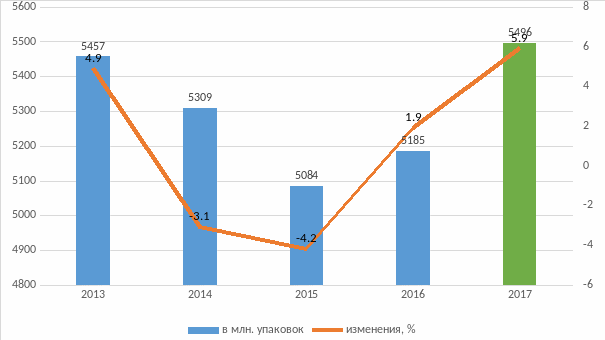
Figure 5 The volume of commercial market of medicines, billion packs
As for the drug production in our country, about 90% of the products manufactured at 168 enterprises, who make up the capacity of national pharmaceutical industry. Of all the national enterprises of chemical-pharmaceutical industry in Russia today there are 487. And if you consider all manufacturers of drugs in the Russian market in March of 2017, there were 997.
If to move on to the retail sales of drugs in Russia from the point of view of country of origin, the ten largest companies-manufacturers, presented in the Russian retail chain, accounted for 33.6% of the Russian market (30% for foreign companies). Except the company Otcpharm with a market share of 3.5%, the national manufacturers in the Top 10 in Russia don’t presented (table 3).
Table 3 Top 10 manufacturers of medicine in Russian market in 2016-2017
| Rating | The manufacturer | Market share, % | ||
| 2016 | 2017 | 2016 | 2017 | |
| 1 | 1 | Bayer (Germany) | 4,9 | 4,9 |
| 2 | 2 | Sanofi-Aventis (France) | 4,6 | 4,0 |
| 3 | 3 | Novartis (Switzerland) | 4,1 | 4,0 |
| 5 | 4 | Отисифарм (Russia) | 3,2 | 3,5 |
| 4 | 5 | Servier (France) | 3,4 | 3,2 |
| 6 | 6 | Takeda (Japan) | 3,1 | 3,1 |
| 7 | 7 | GlaxoSmithKline (UK) | 3,0 | 2,8 |
| 11 | 8 | Stada (Germany) | 2,5 | 2,7 |
| 8 | 9 | Teva (Israel) | 2,9 | 2,7 |
| 9 | 10 | Berlin-Chemie (Germany) | 2,8 | 2,6 |
| Total share of top 10 | 34,3 | 33,6 | ||
The composition of the companies included in the TOP 10 in the commercial pharmaceutical market in Russia, little changed compared to March 2016: rating left Johnson & Johnson. It should be noted, the movement of Stada, occupied the eleventh place in 2016, to the eighth line of the rating. Teva failed to hold his position, with the result that it dropped to 9th place.
Studying national pharmaceutical companies, you can come to the sad conclusion that they inferior to foreign pharmaceutical companies in sales. If we compare the performance of corporations of Big Pharma and of the Russian national pharmaceutical companies, the sales of the last are about a thousand times less (table 4).

















